The Morning report is project which combines both Unit 2: Communication Skills for Creative Media Production as well as Unit 11: Understanding the Print-based Media Industries together.
Our scenario is a lengthy and long one which entails everything we must have learnt and have to do in order to pass this project. Ultimately it comes down to coming together at the end, as a group and producing a newspaper in a day as if it were like in a professional company by todays standards.
Before this thought, we will go over and cover various different job roles as well as legal implications, trade unions and how a CV is proposed and what you should put into one to name a few. After that, we pick a job role and pursue that further, making contact with an industry professional on the chosen job role. Then we can plan questions to interview them with before making a double page spread about it and how to fulfil that particular job within the industry.

Task 1 - Research and Interview
Task 1 serves as start of the project where we go back, using primary and secondary research to become knowledgable but also refresh ourselves on everything to do with working within a Print-based Media Company. We also go over new topics such as employment contracts for instance.
This also acts as a means to show are interview with an industry professional and the results and evidence which come with it. Everything done within task 1 will act as a valuable tool within the project at a later date.
Task 1 contains -
This also acts as a means to show are interview with an industry professional and the results and evidence which come with it. Everything done within task 1 will act as a valuable tool within the project at a later date.
Task 1 contains -
- Research of a job role within the print based media industry
- Research of contracts, legal and ethical issues, professional bodies and working practices
- Comparison of news stories
- Cv and job applications
- Report on how news reporting has changed from 1954-2004
- The process/stages of newspaper production
- Interview of an industry professional
Researching Job Roles within print
Blogger/Vlogger –
A Blogger/Vlogger uses the internet in order to communicate an idea. The purpose is to bring fourth a thought or narrative to a larger audience, this is done to influence people who follow that particular person as an expert in the field and voice in which they can trust.
Art Editor –
An Art Editor creates the overall look of the magazine the company or group is publishing. They make sure the magazine looks attractive and is easy to read for it’s viewer.
Editorial Assistant –
The role of the Editorial Assistant is to help with the running of a publishing house, this means that they make sure everything is in check much like how the lead and main editor would. This covers all parts of the production of the magazine.
Copy Editor –
A Copy Editor’s role is to make sure that the soon to be published piece of work is free of spelling mistakes as well as grammar mistakes.
Translator –
This job is self-explanatory but what a translator does is convert one language to another within the product so that other people from different nationalities or places will be able to read and understand what is being said. The requirements of this job role are demanding as a second language and knowledge about foreign languages is required, as well as understanding cultural differences.
Web Content Manager –
Web Content Managers write content for websites that will attract more viewers as well as appeal to existing followers and fans. Another reason a Web Content Manager exists is to engage the potential new followers as well as existing fans too.
Writer –
The Writer of a publishing company uses descriptive and engaging language in order to create pieces of fictional work, poems and other written forms of art and style.
Technical Author –
A Technical Author job role entitles the use of explaining the technical process of something but in a simple and easy to understand way.
Medical Illustrator –
The Medical Illustrator is a skilled artist of who creates medical related pictures. For someone to fit the role of a Medical Illustrator they must have a keen mind for science and biology as well as have a passion for art.
Journalist –
Journalists research and investigate potential news stories or events of interest, this is done before creating and writing an article for a publication or self-publishing.
Commissioning Editor –
The role of a Commissioning Editor is to find and approve new books and ideas for publishing companies. On top of this, the Commissioning Editor brings them all the way to the printing stage.
Advertising and Editorial Photographer –
An Advertising and Editorial Photographer takes photographs with the purpose of advertising the product. This helps to sell the product or an idea as well as give a better and bigger picture to the contents of the magazine. For example, a certain person on the front page of the magazine with supporting text tells you more about what’s inside the magazine.
Two job roles that require you to multi-skill in Print-based Media
Freelance Sports Journalist/Journalist –
Evidence: https://www.prospects.ac.uk/case-studies/freelance-sports-journalist-matthew-howarth
Matthew Howarth is a freelance sports journalist where he writes about the sports he loves in Germany.
How do you have to multi-skill as a Freelance Journalist?
As a freelance journalist, no two days are the same. This applies to both a freelance and full time journalist for a company. Matthew says that when he works for a company on delivering sports content, he has to go through and write match previews, report on matches, write up news stories as well as analyse and go over results. This includes everything from the write up to gathering photographs and picking out selected highlights and fixtures of the sport. On top of this as a freelance journalist, he also works as a translator for FIFA.com where he translates articles and works on the FIFA weekly football magazine from home.
Copy Editor –
Evidence: https://creativeskillset.org/job_roles/4267_copy_editor
The website providing the information does not have a case study in which someone actually under goes but instead the lowdown on the different skills you’ll need and what the job actually contains.
How do you have to multi-skill as a Copy Editor?
A Copy Editor fills two different roles within a print-based media company. The first role of which the person must fill is to fix grammar and spelling mistakes within a book or article before its published. In addition, the Copy Editor also checks the facts and statements used in the publication to make sure they are correct and not false. Because of what tasks you will be completing, this makes for a very detail-orientated job which naturally requires a lot of concentration and a high level of understanding the English language.
Group B Padlet combination of job roles within print

This shows everything Group B (Including me) has produced on the topic of job roles within print. Each post features a job role and our own description of that job role, some are more in depth than others but all keep to the point and clearly explain what is what and what happens in that job role. We also put our names next to a chosen job role to interview an industry professional of.
In my case, I chose the job role of a writer and would like to pursue that further later on in the blog where I will be interviewing an industry professional on everything required to do the job.
A Blogger/Vlogger uses the internet in order to communicate an idea. The purpose is to bring fourth a thought or narrative to a larger audience, this is done to influence people who follow that particular person as an expert in the field and voice in which they can trust.
Art Editor –
An Art Editor creates the overall look of the magazine the company or group is publishing. They make sure the magazine looks attractive and is easy to read for it’s viewer.
Editorial Assistant –
The role of the Editorial Assistant is to help with the running of a publishing house, this means that they make sure everything is in check much like how the lead and main editor would. This covers all parts of the production of the magazine.
Copy Editor –
A Copy Editor’s role is to make sure that the soon to be published piece of work is free of spelling mistakes as well as grammar mistakes.
Translator –
This job is self-explanatory but what a translator does is convert one language to another within the product so that other people from different nationalities or places will be able to read and understand what is being said. The requirements of this job role are demanding as a second language and knowledge about foreign languages is required, as well as understanding cultural differences.
Web Content Manager –
Web Content Managers write content for websites that will attract more viewers as well as appeal to existing followers and fans. Another reason a Web Content Manager exists is to engage the potential new followers as well as existing fans too.
Writer –
The Writer of a publishing company uses descriptive and engaging language in order to create pieces of fictional work, poems and other written forms of art and style.
Technical Author –
A Technical Author job role entitles the use of explaining the technical process of something but in a simple and easy to understand way.
Medical Illustrator –
The Medical Illustrator is a skilled artist of who creates medical related pictures. For someone to fit the role of a Medical Illustrator they must have a keen mind for science and biology as well as have a passion for art.
Journalist –
Journalists research and investigate potential news stories or events of interest, this is done before creating and writing an article for a publication or self-publishing.
Commissioning Editor –
The role of a Commissioning Editor is to find and approve new books and ideas for publishing companies. On top of this, the Commissioning Editor brings them all the way to the printing stage.
Advertising and Editorial Photographer –
An Advertising and Editorial Photographer takes photographs with the purpose of advertising the product. This helps to sell the product or an idea as well as give a better and bigger picture to the contents of the magazine. For example, a certain person on the front page of the magazine with supporting text tells you more about what’s inside the magazine.
Two job roles that require you to multi-skill in Print-based Media
Freelance Sports Journalist/Journalist –
Evidence: https://www.prospects.ac.uk/case-studies/freelance-sports-journalist-matthew-howarth
Matthew Howarth is a freelance sports journalist where he writes about the sports he loves in Germany.
How do you have to multi-skill as a Freelance Journalist?
As a freelance journalist, no two days are the same. This applies to both a freelance and full time journalist for a company. Matthew says that when he works for a company on delivering sports content, he has to go through and write match previews, report on matches, write up news stories as well as analyse and go over results. This includes everything from the write up to gathering photographs and picking out selected highlights and fixtures of the sport. On top of this as a freelance journalist, he also works as a translator for FIFA.com where he translates articles and works on the FIFA weekly football magazine from home.
Copy Editor –
Evidence: https://creativeskillset.org/job_roles/4267_copy_editor
The website providing the information does not have a case study in which someone actually under goes but instead the lowdown on the different skills you’ll need and what the job actually contains.
How do you have to multi-skill as a Copy Editor?
A Copy Editor fills two different roles within a print-based media company. The first role of which the person must fill is to fix grammar and spelling mistakes within a book or article before its published. In addition, the Copy Editor also checks the facts and statements used in the publication to make sure they are correct and not false. Because of what tasks you will be completing, this makes for a very detail-orientated job which naturally requires a lot of concentration and a high level of understanding the English language.
Group B Padlet combination of job roles within print

In my case, I chose the job role of a writer and would like to pursue that further later on in the blog where I will be interviewing an industry professional on everything required to do the job.
How digital media has changed the working practices within newspapers and magazines
The world and technology in it has progressed a lot from when it began, from using sticks to create fire, to now robots capable of running and getting up when pushed over as well as beating a human at chess. Technological advancement is around us all the time and can be seen in every field and category of life.
In the newspaper and magazine industry, this is the exact same with the advancement we’ve made in digital communication and how far we’ve come also with access to online resources world wide.
Because of all this, the work process and way in which journalistic content has trained is now different. Journalists aren’t necessarily taught to write content for print but for online now as well. This meant that in the time a lot of newspapers started switching to online production as well, a lot of people had to adapt and get used to writing for online publication.
To further drive this point forward, newspaper and magazine companies now focus a lot more on their digital publication than the daily printed version but that’s not to blame to the publishers. Fact of the matter is, there is a lot more which can be done with online publication which why numbers show the decline in readers of big industry newspapers via physical copy.
It is for the best that newspaper companies follow and invest into what is currently trending to deliver content. This includes social media. Switching or being to switch covering content online will always win because of the convenience which comes with it, people don’t want to go out and purchase a paper when they can just read it online so companies have to adapt.
In the newspaper and magazine industry, this is the exact same with the advancement we’ve made in digital communication and how far we’ve come also with access to online resources world wide.
Because of all this, the work process and way in which journalistic content has trained is now different. Journalists aren’t necessarily taught to write content for print but for online now as well. This meant that in the time a lot of newspapers started switching to online production as well, a lot of people had to adapt and get used to writing for online publication.
To further drive this point forward, newspaper and magazine companies now focus a lot more on their digital publication than the daily printed version but that’s not to blame to the publishers. Fact of the matter is, there is a lot more which can be done with online publication which why numbers show the decline in readers of big industry newspapers via physical copy.
It is for the best that newspaper companies follow and invest into what is currently trending to deliver content. This includes social media. Switching or being to switch covering content online will always win because of the convenience which comes with it, people don’t want to go out and purchase a paper when they can just read it online so companies have to adapt.
Trade Unions
What is a trade union?
A Trade Union is an organisation made up of members which is made up of predominantly workers. Out of the many different roles a trade union has, one of its main ones is to protect and advance the interests of its members in the work place.
Now we know what a trade union is, its important to know what the actual purpose of one is, in depth.
Trade unions are mostly independent of any employers but try to develop close working relationships between its employers, this can take on the form of a partnership agreement of which the employer and the trade union identifies their common interests and objects.
A Trade Union is an organisation made up of members which is made up of predominantly workers. Out of the many different roles a trade union has, one of its main ones is to protect and advance the interests of its members in the work place.
Now we know what a trade union is, its important to know what the actual purpose of one is, in depth.
Trade unions are mostly independent of any employers but try to develop close working relationships between its employers, this can take on the form of a partnership agreement of which the employer and the trade union identifies their common interests and objects.
Trade unions also:
- Negotiate agreements with other employers on pay and conditions
- Discuss big changes to the workplace, an example of this is a large scale redundancy
- Discuss the concerns of members with other employers within the union
- Appear as an accomplice for members in disciplinary and grievance meetings
- Provide members with legal and financial advice
- Provide education facilities and certain consumer benefits such as discounted insurance
Two trade unions in the print-based media industry -
Trade Union one – Graphical, Paper and Media Union
The GPMU first came to being on the 30th of September 1991 when the National Graphic Association and the society of Graphical and Allied Trades came together. Over a long period of time, 50 trade unions have come together to form the GPMU and the trade union doesn’t just account for the printing, packaging, publishing and papermaking industries anymore.
GPMU was based solely in the UK and Ireland and had 200,000 members before dissolving and merging into Amicus in 2005. Since then Amicus had over 1.2 million members before later merging into Unite.
Unite the union is now the largest trade union in the UK and Ireland and covers more than just the printing industry with different sectors inside of it. Unite now has over 1,420,000 members and merged with the United Steelworks to form a global union called Workers Uniting which now represents over 3 million members from the UK, Ireland, North America and the Caribbean.
The General Secretary of Unite is Len McCluskey who was born in July of 1950 on the 23rd. Before becoming the General Secretary of Unite we spent years working on the Liverpool Docks and was elected as the General Secretary of Unite in 2010 after the retirement of Derek Simpson and Tony Woodley. He also re-ran for the position in 2013 to which he won again with 144,570 votes to 79,819 of Jerry Hicks.
Trade Union two – National Union of Journalists
The NUJ is a trade union for journalists in the United Kingdom and Ireland, it was founded in 1907 and since has over 38,000 members. The trade union itself represents members in numerous different sectors of journalistic content ranging from newspapers and agencies to magazines and broadcasting.
Within categories such as a broadcasting company and magazine developer and publisher all job roles are covered, for example the ones below:
Trade Union one – Graphical, Paper and Media Union
The GPMU first came to being on the 30th of September 1991 when the National Graphic Association and the society of Graphical and Allied Trades came together. Over a long period of time, 50 trade unions have come together to form the GPMU and the trade union doesn’t just account for the printing, packaging, publishing and papermaking industries anymore.
GPMU was based solely in the UK and Ireland and had 200,000 members before dissolving and merging into Amicus in 2005. Since then Amicus had over 1.2 million members before later merging into Unite.
Unite the union is now the largest trade union in the UK and Ireland and covers more than just the printing industry with different sectors inside of it. Unite now has over 1,420,000 members and merged with the United Steelworks to form a global union called Workers Uniting which now represents over 3 million members from the UK, Ireland, North America and the Caribbean.
The General Secretary of Unite is Len McCluskey who was born in July of 1950 on the 23rd. Before becoming the General Secretary of Unite we spent years working on the Liverpool Docks and was elected as the General Secretary of Unite in 2010 after the retirement of Derek Simpson and Tony Woodley. He also re-ran for the position in 2013 to which he won again with 144,570 votes to 79,819 of Jerry Hicks.
Trade Union two – National Union of Journalists
The NUJ is a trade union for journalists in the United Kingdom and Ireland, it was founded in 1907 and since has over 38,000 members. The trade union itself represents members in numerous different sectors of journalistic content ranging from newspapers and agencies to magazines and broadcasting.
Within categories such as a broadcasting company and magazine developer and publisher all job roles are covered, for example the ones below:
- Art Editor
- Editor
- Newspaper correspondent
- Columnist
…To name a few.
Since its founding in 1907 the union has had over eleven different General Secretaries spanning from its founding to 2011 where Michelle Stanistreet has been the General Secretary for 5 years now.
Michelle Stanistreet became the first woman deputy General Secretary when she was elected in 2008 and after Jeremy Dear stepping down, became the first woman General Secretary in April 2011. Prior to this, she worked as a journalist for ten years at the Sunday Express where she was a feature writer and books editor.
Since its founding in 1907 the union has had over eleven different General Secretaries spanning from its founding to 2011 where Michelle Stanistreet has been the General Secretary for 5 years now.
Michelle Stanistreet became the first woman deputy General Secretary when she was elected in 2008 and after Jeremy Dear stepping down, became the first woman General Secretary in April 2011. Prior to this, she worked as a journalist for ten years at the Sunday Express where she was a feature writer and books editor.
Types of employment contracts
Permanent employment contract – A permanent contract within employment is the most common type, this is where the contract between you and the employer is indefinite, meaning never ending until the employer or employee no longer wishes to work there.
The contract itself is an agreement between you the employee and the employer to which the employer provides work for you to do in exchange for a paid salary. In addition, the employee is obliged to work towards the work set and if they refuse to, they are in breach of the contract. This will result in the loss of the job or the employee.
A principal statement (Legal name of the employer company, legal name of the employee, job title, the date the employment began, the employee’s work hours, entitlement to holidays and address of the the employee’s place of work) is required on the contract as well.
Temporary employment contract – A temporary employment contract, also known as a fixed-term employment contract is a contract of which ends on a particular date or as a specific task or project is completed. A contract is not a fixed-term contract if the employee has a contract with an agency rather than a company, is a student or trainee on a work-experience placement or is working under an apprenticeship or are a member of the armed forces.
One big rule of a fixed-term contract is that the employer of those who have employed people under fixed-term contracts must be treated the same as those on permanent employment contracts. Each employee, regardless of their contract must be treated equally and be doing the same or a similar job of length and time. They must also receive the same pay and conditions, the same or an equivalent of benefit packages and protection from redundancy or dismissal. The only time a fixed-term employee may not work the same hours or perform the same tasks is if there is a good business reason to do so, also known as Object Justification.
Fixed-term employment contracts can however be renewed after the original one has ended. This must be done by negotiation with the employer though on bad terms, this may provide futile and an agreement won’t be made. On the other hand, a contract can be ended earlier too. This is dependent on what is written on the contract but the most common way in which this is done between employers and employees is that the employee must hand in their notice a week in advance and only if they have worked for an employer for a month or more.
Full-time employment contract – Full-time employment is when an employee is made to work a minimum number of hours defined by his/her employer. It is different to that of a fixed-term or part-time employment as Full-time employment comes with a handful of extra benefits. The following benefits are:
Annual leave
Sick leave
Health insurance
Being things such as a teacher or editor for a magazine for example are treated as full-time employment and can be watered down to cover all careers. Like how a teacher is different to someone who works at a checkout, working at the checkout is not a career as per say.
A standard week of work for an employee under a full-time contract consists of five, eight hour days and is most commonly served between 9AM to 5PM and generally pay more than that of a part-time contract. For a contract to be considered a full-time contract the employee must work 36 hours a week and overtime is legally paid out when the employee works more than 40 hours per that week.
Zero hours contract - Recently, zero hour contracts have been quite controversial and the government is actually currently in the process of creating restrictions and changing how zero hours contracts can be used.
This is different to a normal employment contract as instead of creating a mutual obligation between the employer and employee, where you are provided a certain amount of work and you agreed to go and do it. You instead get a contract which allows the employer to need the employee to come to the work without actually guaranteeing to provide work to the employee. There is a benefit to this though, as the employer can then call upon the services of the employee when needed.
The contract itself is an agreement between you the employee and the employer to which the employer provides work for you to do in exchange for a paid salary. In addition, the employee is obliged to work towards the work set and if they refuse to, they are in breach of the contract. This will result in the loss of the job or the employee.
A principal statement (Legal name of the employer company, legal name of the employee, job title, the date the employment began, the employee’s work hours, entitlement to holidays and address of the the employee’s place of work) is required on the contract as well.
Temporary employment contract – A temporary employment contract, also known as a fixed-term employment contract is a contract of which ends on a particular date or as a specific task or project is completed. A contract is not a fixed-term contract if the employee has a contract with an agency rather than a company, is a student or trainee on a work-experience placement or is working under an apprenticeship or are a member of the armed forces.
One big rule of a fixed-term contract is that the employer of those who have employed people under fixed-term contracts must be treated the same as those on permanent employment contracts. Each employee, regardless of their contract must be treated equally and be doing the same or a similar job of length and time. They must also receive the same pay and conditions, the same or an equivalent of benefit packages and protection from redundancy or dismissal. The only time a fixed-term employee may not work the same hours or perform the same tasks is if there is a good business reason to do so, also known as Object Justification.
Fixed-term employment contracts can however be renewed after the original one has ended. This must be done by negotiation with the employer though on bad terms, this may provide futile and an agreement won’t be made. On the other hand, a contract can be ended earlier too. This is dependent on what is written on the contract but the most common way in which this is done between employers and employees is that the employee must hand in their notice a week in advance and only if they have worked for an employer for a month or more.
Full-time employment contract – Full-time employment is when an employee is made to work a minimum number of hours defined by his/her employer. It is different to that of a fixed-term or part-time employment as Full-time employment comes with a handful of extra benefits. The following benefits are:
Annual leave
Sick leave
Health insurance
Being things such as a teacher or editor for a magazine for example are treated as full-time employment and can be watered down to cover all careers. Like how a teacher is different to someone who works at a checkout, working at the checkout is not a career as per say.
A standard week of work for an employee under a full-time contract consists of five, eight hour days and is most commonly served between 9AM to 5PM and generally pay more than that of a part-time contract. For a contract to be considered a full-time contract the employee must work 36 hours a week and overtime is legally paid out when the employee works more than 40 hours per that week.
Zero hours contract - Recently, zero hour contracts have been quite controversial and the government is actually currently in the process of creating restrictions and changing how zero hours contracts can be used.
This is different to a normal employment contract as instead of creating a mutual obligation between the employer and employee, where you are provided a certain amount of work and you agreed to go and do it. You instead get a contract which allows the employer to need the employee to come to the work without actually guaranteeing to provide work to the employee. There is a benefit to this though, as the employer can then call upon the services of the employee when needed.
Knowing the Legal in Print Media
Task 1:
Scenario -
You are a showbiz journalist and have been given a good tip by a reliable contact that an A-list celebrity is having a secret relationship with a married Premiership footballer. How would the legal term of libel (defamation) apply and what legal aspects would you have to take into consideration before your story is published?
Definition of Libel -
The legally indefensible publication or broadcast of words or images that are degrading a person or injurious to his or her reputation.
Answer to the scenario -
A big thing for the news is always to only publish and present what is complete fact, this is important because libel can take into affect here. Even if it is the truth, you must back it up, have an official statement and make a story on it after it has happened. You aren't allowed to make a story on the something which is based on speculation as that wouldn't be classified as news. For harmless topics this can be allowed but wouldn't be published from any big producer of the news today.
In this case, we are dealing with something highly controversial and also something which could be damaging to the reputation of both parties involved. This is why I mentioned that its important not to report on speculation or something which might not be completely true. Often though, you will see gossip magazines and such report on a story like this after its already happened and been made public by someone directly involved.
Avoiding breaking the law by not publishing a story based speculation is not only good journalistic practice but also keeps you and your company from being under fire and sued for millions potentially. This is the exact same in how a journalist should only report what is complete fact, lying will only get everyone into trouble as well as anyone else who may use that piece of information. Even if they quote you in and say where the information you got was sourced.
Task 2:
For task two I found a website in which went over some of the not only most well know cases of libel but also successful, the full site can be found here as its an interesting read: http://www.insidecounsel.com/2014/11/18/6-most-successful-celebrity-libel-and-slander-case?slreturn=1465232280
In specific, I want to focus on the 2nd story written here as its the one that stands out to me the most.
So what happened?
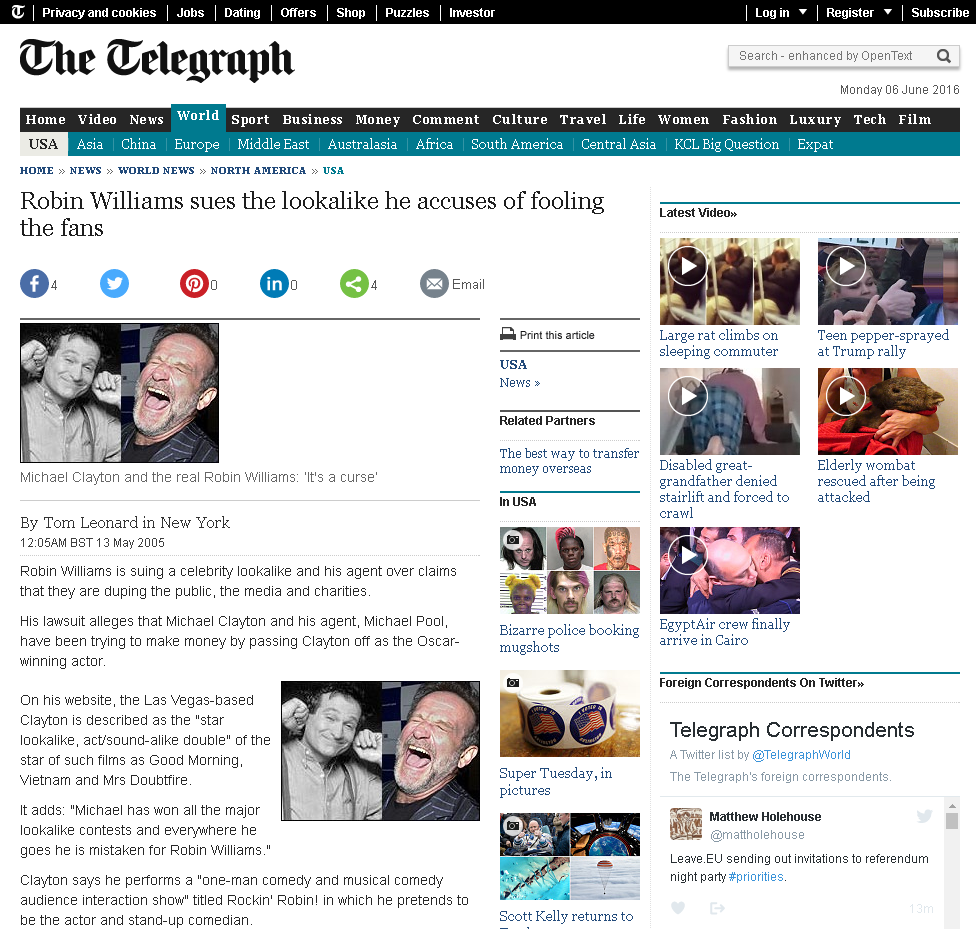
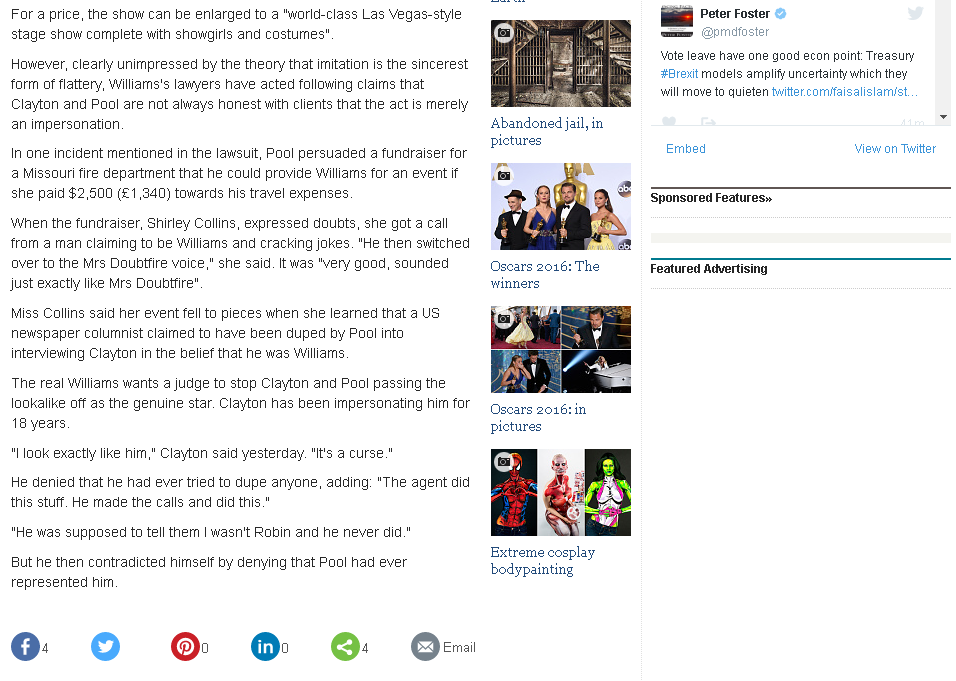
A look-alike of Robin Williams and his agent were pretending to be the actual Robin Williams where the look-alike was actually cheating charities under the name of Robin Williams. In turn this caused a lot of damage to Robin Williams' name and reputation.
Another article on the matter can be found here in which the Telegraph took their take on the turn of events:
http://www.telegraph.co.uk/news/worldnews/northamerica/usa/1489946/Robin-Williams-sues-the-lookalike-he-accuses-of-fooling-the-fans.html
The story pasted here -
Scenario -
You are a showbiz journalist and have been given a good tip by a reliable contact that an A-list celebrity is having a secret relationship with a married Premiership footballer. How would the legal term of libel (defamation) apply and what legal aspects would you have to take into consideration before your story is published?
Definition of Libel -
The legally indefensible publication or broadcast of words or images that are degrading a person or injurious to his or her reputation.
Answer to the scenario -
A big thing for the news is always to only publish and present what is complete fact, this is important because libel can take into affect here. Even if it is the truth, you must back it up, have an official statement and make a story on it after it has happened. You aren't allowed to make a story on the something which is based on speculation as that wouldn't be classified as news. For harmless topics this can be allowed but wouldn't be published from any big producer of the news today.
In this case, we are dealing with something highly controversial and also something which could be damaging to the reputation of both parties involved. This is why I mentioned that its important not to report on speculation or something which might not be completely true. Often though, you will see gossip magazines and such report on a story like this after its already happened and been made public by someone directly involved.
Avoiding breaking the law by not publishing a story based speculation is not only good journalistic practice but also keeps you and your company from being under fire and sued for millions potentially. This is the exact same in how a journalist should only report what is complete fact, lying will only get everyone into trouble as well as anyone else who may use that piece of information. Even if they quote you in and say where the information you got was sourced.
Task 2:
For task two I found a website in which went over some of the not only most well know cases of libel but also successful, the full site can be found here as its an interesting read: http://www.insidecounsel.com/2014/11/18/6-most-successful-celebrity-libel-and-slander-case?slreturn=1465232280
In specific, I want to focus on the 2nd story written here as its the one that stands out to me the most.
So what happened?
A look-alike of Robin Williams and his agent were pretending to be the actual Robin Williams where the look-alike was actually cheating charities under the name of Robin Williams. In turn this caused a lot of damage to Robin Williams' name and reputation.
Another article on the matter can be found here in which the Telegraph took their take on the turn of events:
http://www.telegraph.co.uk/news/worldnews/northamerica/usa/1489946/Robin-Williams-sues-the-lookalike-he-accuses-of-fooling-the-fans.html
The story pasted here -
My findings -
From this article we get to follow the story of Robin Williams and his proceedings in suing the look-alike of him who cheated charities and in Robins words, fooled the fans.
It's also important to point out this article underlines how serious this issue is and how its dealt with and same with the other article posted above, its not the only time defamation has happened, this has happened a lot.
Task 3:
Scenario -
you are about to publish an online book, via Kindle, which is your own creation. Why would the law of UK Copyright be so significant?
Answer to the scenario -
From this article we get to follow the story of Robin Williams and his proceedings in suing the look-alike of him who cheated charities and in Robins words, fooled the fans.
It's also important to point out this article underlines how serious this issue is and how its dealt with and same with the other article posted above, its not the only time defamation has happened, this has happened a lot.
Task 3:
Scenario -
you are about to publish an online book, via Kindle, which is your own creation. Why would the law of UK Copyright be so significant?
Answer to the scenario -
Copyright
when publishing anything anywhere is always an underlying factor.
In this
scenario, we’ll be publishing a book online to Kindle. Copyright comes in
extremely helpful here as often, online, it is common that a lot of things can
be illegally downloaded or plagiarised with little consequences because of it.
There’s a certain level of anonymity in which a person can hide behind when
online and it is abused every minute.
Because of
this, you want to stay clear of copyright laws and not fall under receiving
legal action taken against you. Everything in your book should be your original
and own content. If it is sourced from somewhere, it should be your own words
with references made to where you sourced the information at the end of the
book. Plagiarising is against the law and you will be breaking copyright laws
by failing to not put your own writing into it.
Unfortunately,
it doesn’t end there for copyright. On top of this, another part of copyright
that you have to abide by is having a unique title for your book. This is
important in particular because like how you can’t make your own drink and name
it Coca-Cola, you can’t produce a book and call it James and the Giant Peach.
It has to be your own and original.
Copyright
is a form of intellectual property, and so by staying in line with the law of
copyright, your own worked will be protected as well as not being in trouble
with others and the work they have produced.
So assuming
all of the content of your book is completely yours unless sourced correctly
and produced for educational use with the consent of the original author, as
well as the title of your book is your own, everything should be in check. Your
book after meeting all these requirements will then be able to be published if
Kindle decides to take on your book and feature it in their library.
If you
violate copyright law, you can and will be given a fine or complete rejection
from whoever you are trying to get to publish your book. Even if a publisher
takes on your book and it is then produced and sold, you can’t still get into
legal trouble, as well as the publisher.
Cases where
the original publisher of whose work you’ve copied finds out and then decides
to threat legal action against you or even take you straight to court to sue
you for copyright can still happen and its not extremely uncommon. Copyright infringement
happens often in todays world, especially in publishing and media creation.
Subscribe to:
Comments (Atom)