Pre-planning to interview an industry professional
Research somebody who works in that role
SHOW:
- Examples of their work
- 10 questions of which you will email to the person
- Provide evidence by showing emails as well as the answers & replies
Alternative – Chief Editor via email found below
Contact Information –
Twitter: @Mark_Lynas
Email to National Geographic: ngsforum@nationalgeographic.com
Questions to ask –
1. Is time management important in a job like yours?
2. What equipment is required in order to fulfil tasks set?
3. What kind of entry requirements are there for a job such as your own?
4. How much knowledge and understanding of the job role is needed to perform tasks set effectively?
5. What is the location of which you work in? – In an office/offsite?
6. What qualifications and work experience do you have and do you think they have helped you in your field of work?
7. How long are the working hours you take in each week?
8. Is the ability of working with others something you need, or is it possible to do your job alone?
9. What kind of employment contract do you work under and what can someone wishing to do this job this job expect in terms of contracts?
10. What is the basic salary you typically earn for a job such as your own?
The results of the interview
1) Time keeping is essential in any job but as a writer where you’re constantly having to come up with something this all comes together a lot more. The National Geographic Magazine isn’t published everyday like a newspaper and the work you have been doing is done but its still important as you need to meet deadlines when set, wherever you are or whatever you work for.
2) Generally the equipment needed for a writer is pretty standard. A computer alongside other things as a notepad, pen and paper are all needed. If I find out information whilst out and on the go, I can easily write it down and relay that information for later use. In terms of the pre-production to producing a story, evidence of phone calls and recordings of things that have been said also provide as an invaluable source for a writer. Especially one that writes about current events and happenings in the world.
3) Well first of all, the ability to write and be fluent in English is a given. Aside from that there are no real qualifications that are required but such things as doing a course in journalism or a communications and media studies course will definitely help your chances. The key set of skills you can have for a job like this is to be able to write well and be understanding of what the target audience likes to see and is easy to read for them.
4) This is a lot similar to the previous question, to be a writer you need to be talented in what you do. Have a strong mental attitude towards your work and don’t entirely push yourself beyond the limits of what you enjoy but also don’t forget you may have deadlines to which you have to meet. A good understanding of the English language and appropriate writing skills are your best bet when it comes to knowledge and understanding of being a writer.
5) As a writer, I will always be on the move getting firsthand in the experience of what I will be writing about, so because of this I don’t typically work in an office all the time. This doesn’t meant to say I don’t have an office or work in it when i’m not out trying to get primary research.
6) I graduated at the University of Edinburgh with a degree in history and politics so there was a certain level of natural writing ability with me before actually becoming a writer for the National Geographic. I have also published several books such as Six Degrees: Our Future on a Hotter Planet which talks about geographical and environmental issues. I have a real passion for everything the National Geographic stands for and so if I was to say if it had helped me or not, I’d say yes.
7) My working hours are actually variable and there is no set amount of working hours each day. Typically I still run under a full time contract though, which means I still commit to 36 hours a week minimum but do upwards of 40 hours a week. It all depends on whether or not i’m ahead of schedule as well as how big the project i’m undertaking will be.
8) This is highly dependent on what stage I am in as my job of a writer. If I can still gathering information and sourcing idea’s from places I will be working with others who have information for me or going out with them to write down concepts in my notepad. If i’m in the process of actually writing the article or story I am working on, it doesn’t happen so much but does if I need help or my work gets checked over to make sure its suitable.
9) Without knowing, I kind of answered this in an earlier question but to relay information, I work a full time contract at the National Geographic. This means I work 36 hours a week minimum as well as get paid more for doing overtime (upwards of 40 hours a week). Someone who wishes to work as a writer for any company should expect a permanent position straight away unless the company is asking for that, many smaller businesses offer writers coming straight out of university or even college part time places as a junior writer.
10) Salaries for writers are not exactly the highest when starting out, in some instances you could be working at a rate of less than minimum wage but as you start to become more professional and higher up companies will be looking for your services, you can expect anywhere from up to £111,000 a year.
Evidence of the interview
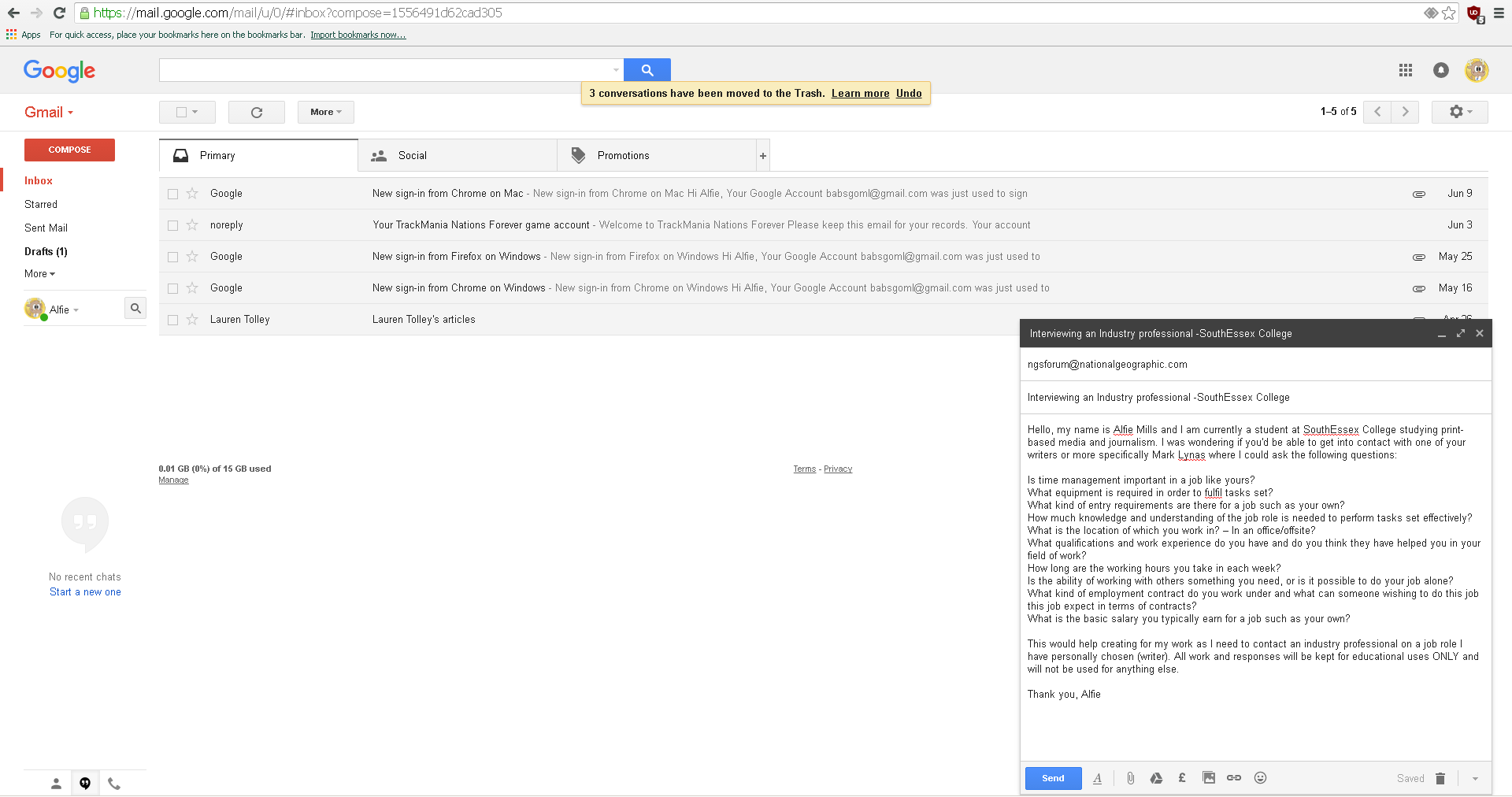 |
| Composing the email to National Geographic Magazine |
 |
| Response to my original email |

No comments:
Post a Comment