The Morning report is project which combines both Unit 2: Communication Skills for Creative Media Production as well as Unit 11: Understanding the Print-based Media Industries together.
Our scenario is a lengthy and long one which entails everything we must have learnt and have to do in order to pass this project. Ultimately it comes down to coming together at the end, as a group and producing a newspaper in a day as if it were like in a professional company by todays standards.
Before this thought, we will go over and cover various different job roles as well as legal implications, trade unions and how a CV is proposed and what you should put into one to name a few. After that, we pick a job role and pursue that further, making contact with an industry professional on the chosen job role. Then we can plan questions to interview them with before making a double page spread about it and how to fulfil that particular job within the industry.

Task 1 - Research and Interview
Task 1 serves as start of the project where we go back, using primary and secondary research to become knowledgable but also refresh ourselves on everything to do with working within a Print-based Media Company. We also go over new topics such as employment contracts for instance.
This also acts as a means to show are interview with an industry professional and the results and evidence which come with it. Everything done within task 1 will act as a valuable tool within the project at a later date.
Task 1 contains -
This also acts as a means to show are interview with an industry professional and the results and evidence which come with it. Everything done within task 1 will act as a valuable tool within the project at a later date.
Task 1 contains -
- Research of a job role within the print based media industry
- Research of contracts, legal and ethical issues, professional bodies and working practices
- Comparison of news stories
- Cv and job applications
- Report on how news reporting has changed from 1954-2004
- The process/stages of newspaper production
- Interview of an industry professional
Researching Job Roles within print
Blogger/Vlogger –
A Blogger/Vlogger uses the internet in order to communicate an idea. The purpose is to bring fourth a thought or narrative to a larger audience, this is done to influence people who follow that particular person as an expert in the field and voice in which they can trust.
Art Editor –
An Art Editor creates the overall look of the magazine the company or group is publishing. They make sure the magazine looks attractive and is easy to read for it’s viewer.
Editorial Assistant –
The role of the Editorial Assistant is to help with the running of a publishing house, this means that they make sure everything is in check much like how the lead and main editor would. This covers all parts of the production of the magazine.
Copy Editor –
A Copy Editor’s role is to make sure that the soon to be published piece of work is free of spelling mistakes as well as grammar mistakes.
Translator –
This job is self-explanatory but what a translator does is convert one language to another within the product so that other people from different nationalities or places will be able to read and understand what is being said. The requirements of this job role are demanding as a second language and knowledge about foreign languages is required, as well as understanding cultural differences.
Web Content Manager –
Web Content Managers write content for websites that will attract more viewers as well as appeal to existing followers and fans. Another reason a Web Content Manager exists is to engage the potential new followers as well as existing fans too.
Writer –
The Writer of a publishing company uses descriptive and engaging language in order to create pieces of fictional work, poems and other written forms of art and style.
Technical Author –
A Technical Author job role entitles the use of explaining the technical process of something but in a simple and easy to understand way.
Medical Illustrator –
The Medical Illustrator is a skilled artist of who creates medical related pictures. For someone to fit the role of a Medical Illustrator they must have a keen mind for science and biology as well as have a passion for art.
Journalist –
Journalists research and investigate potential news stories or events of interest, this is done before creating and writing an article for a publication or self-publishing.
Commissioning Editor –
The role of a Commissioning Editor is to find and approve new books and ideas for publishing companies. On top of this, the Commissioning Editor brings them all the way to the printing stage.
Advertising and Editorial Photographer –
An Advertising and Editorial Photographer takes photographs with the purpose of advertising the product. This helps to sell the product or an idea as well as give a better and bigger picture to the contents of the magazine. For example, a certain person on the front page of the magazine with supporting text tells you more about what’s inside the magazine.
Two job roles that require you to multi-skill in Print-based Media
Freelance Sports Journalist/Journalist –
Evidence: https://www.prospects.ac.uk/case-studies/freelance-sports-journalist-matthew-howarth
Matthew Howarth is a freelance sports journalist where he writes about the sports he loves in Germany.
How do you have to multi-skill as a Freelance Journalist?
As a freelance journalist, no two days are the same. This applies to both a freelance and full time journalist for a company. Matthew says that when he works for a company on delivering sports content, he has to go through and write match previews, report on matches, write up news stories as well as analyse and go over results. This includes everything from the write up to gathering photographs and picking out selected highlights and fixtures of the sport. On top of this as a freelance journalist, he also works as a translator for FIFA.com where he translates articles and works on the FIFA weekly football magazine from home.
Copy Editor –
Evidence: https://creativeskillset.org/job_roles/4267_copy_editor
The website providing the information does not have a case study in which someone actually under goes but instead the lowdown on the different skills you’ll need and what the job actually contains.
How do you have to multi-skill as a Copy Editor?
A Copy Editor fills two different roles within a print-based media company. The first role of which the person must fill is to fix grammar and spelling mistakes within a book or article before its published. In addition, the Copy Editor also checks the facts and statements used in the publication to make sure they are correct and not false. Because of what tasks you will be completing, this makes for a very detail-orientated job which naturally requires a lot of concentration and a high level of understanding the English language.
Group B Padlet combination of job roles within print

This shows everything Group B (Including me) has produced on the topic of job roles within print. Each post features a job role and our own description of that job role, some are more in depth than others but all keep to the point and clearly explain what is what and what happens in that job role. We also put our names next to a chosen job role to interview an industry professional of.
In my case, I chose the job role of a writer and would like to pursue that further later on in the blog where I will be interviewing an industry professional on everything required to do the job.
A Blogger/Vlogger uses the internet in order to communicate an idea. The purpose is to bring fourth a thought or narrative to a larger audience, this is done to influence people who follow that particular person as an expert in the field and voice in which they can trust.
Art Editor –
An Art Editor creates the overall look of the magazine the company or group is publishing. They make sure the magazine looks attractive and is easy to read for it’s viewer.
Editorial Assistant –
The role of the Editorial Assistant is to help with the running of a publishing house, this means that they make sure everything is in check much like how the lead and main editor would. This covers all parts of the production of the magazine.
Copy Editor –
A Copy Editor’s role is to make sure that the soon to be published piece of work is free of spelling mistakes as well as grammar mistakes.
Translator –
This job is self-explanatory but what a translator does is convert one language to another within the product so that other people from different nationalities or places will be able to read and understand what is being said. The requirements of this job role are demanding as a second language and knowledge about foreign languages is required, as well as understanding cultural differences.
Web Content Manager –
Web Content Managers write content for websites that will attract more viewers as well as appeal to existing followers and fans. Another reason a Web Content Manager exists is to engage the potential new followers as well as existing fans too.
Writer –
The Writer of a publishing company uses descriptive and engaging language in order to create pieces of fictional work, poems and other written forms of art and style.
Technical Author –
A Technical Author job role entitles the use of explaining the technical process of something but in a simple and easy to understand way.
Medical Illustrator –
The Medical Illustrator is a skilled artist of who creates medical related pictures. For someone to fit the role of a Medical Illustrator they must have a keen mind for science and biology as well as have a passion for art.
Journalist –
Journalists research and investigate potential news stories or events of interest, this is done before creating and writing an article for a publication or self-publishing.
Commissioning Editor –
The role of a Commissioning Editor is to find and approve new books and ideas for publishing companies. On top of this, the Commissioning Editor brings them all the way to the printing stage.
Advertising and Editorial Photographer –
An Advertising and Editorial Photographer takes photographs with the purpose of advertising the product. This helps to sell the product or an idea as well as give a better and bigger picture to the contents of the magazine. For example, a certain person on the front page of the magazine with supporting text tells you more about what’s inside the magazine.
Two job roles that require you to multi-skill in Print-based Media
Freelance Sports Journalist/Journalist –
Evidence: https://www.prospects.ac.uk/case-studies/freelance-sports-journalist-matthew-howarth
Matthew Howarth is a freelance sports journalist where he writes about the sports he loves in Germany.
How do you have to multi-skill as a Freelance Journalist?
As a freelance journalist, no two days are the same. This applies to both a freelance and full time journalist for a company. Matthew says that when he works for a company on delivering sports content, he has to go through and write match previews, report on matches, write up news stories as well as analyse and go over results. This includes everything from the write up to gathering photographs and picking out selected highlights and fixtures of the sport. On top of this as a freelance journalist, he also works as a translator for FIFA.com where he translates articles and works on the FIFA weekly football magazine from home.
Copy Editor –
Evidence: https://creativeskillset.org/job_roles/4267_copy_editor
The website providing the information does not have a case study in which someone actually under goes but instead the lowdown on the different skills you’ll need and what the job actually contains.
How do you have to multi-skill as a Copy Editor?
A Copy Editor fills two different roles within a print-based media company. The first role of which the person must fill is to fix grammar and spelling mistakes within a book or article before its published. In addition, the Copy Editor also checks the facts and statements used in the publication to make sure they are correct and not false. Because of what tasks you will be completing, this makes for a very detail-orientated job which naturally requires a lot of concentration and a high level of understanding the English language.
Group B Padlet combination of job roles within print

In my case, I chose the job role of a writer and would like to pursue that further later on in the blog where I will be interviewing an industry professional on everything required to do the job.
How digital media has changed the working practices within newspapers and magazines
The world and technology in it has progressed a lot from when it began, from using sticks to create fire, to now robots capable of running and getting up when pushed over as well as beating a human at chess. Technological advancement is around us all the time and can be seen in every field and category of life.
In the newspaper and magazine industry, this is the exact same with the advancement we’ve made in digital communication and how far we’ve come also with access to online resources world wide.
Because of all this, the work process and way in which journalistic content has trained is now different. Journalists aren’t necessarily taught to write content for print but for online now as well. This meant that in the time a lot of newspapers started switching to online production as well, a lot of people had to adapt and get used to writing for online publication.
To further drive this point forward, newspaper and magazine companies now focus a lot more on their digital publication than the daily printed version but that’s not to blame to the publishers. Fact of the matter is, there is a lot more which can be done with online publication which why numbers show the decline in readers of big industry newspapers via physical copy.
It is for the best that newspaper companies follow and invest into what is currently trending to deliver content. This includes social media. Switching or being to switch covering content online will always win because of the convenience which comes with it, people don’t want to go out and purchase a paper when they can just read it online so companies have to adapt.
In the newspaper and magazine industry, this is the exact same with the advancement we’ve made in digital communication and how far we’ve come also with access to online resources world wide.
Because of all this, the work process and way in which journalistic content has trained is now different. Journalists aren’t necessarily taught to write content for print but for online now as well. This meant that in the time a lot of newspapers started switching to online production as well, a lot of people had to adapt and get used to writing for online publication.
To further drive this point forward, newspaper and magazine companies now focus a lot more on their digital publication than the daily printed version but that’s not to blame to the publishers. Fact of the matter is, there is a lot more which can be done with online publication which why numbers show the decline in readers of big industry newspapers via physical copy.
It is for the best that newspaper companies follow and invest into what is currently trending to deliver content. This includes social media. Switching or being to switch covering content online will always win because of the convenience which comes with it, people don’t want to go out and purchase a paper when they can just read it online so companies have to adapt.
Trade Unions
What is a trade union?
A Trade Union is an organisation made up of members which is made up of predominantly workers. Out of the many different roles a trade union has, one of its main ones is to protect and advance the interests of its members in the work place.
Now we know what a trade union is, its important to know what the actual purpose of one is, in depth.
Trade unions are mostly independent of any employers but try to develop close working relationships between its employers, this can take on the form of a partnership agreement of which the employer and the trade union identifies their common interests and objects.
A Trade Union is an organisation made up of members which is made up of predominantly workers. Out of the many different roles a trade union has, one of its main ones is to protect and advance the interests of its members in the work place.
Now we know what a trade union is, its important to know what the actual purpose of one is, in depth.
Trade unions are mostly independent of any employers but try to develop close working relationships between its employers, this can take on the form of a partnership agreement of which the employer and the trade union identifies their common interests and objects.
Trade unions also:
- Negotiate agreements with other employers on pay and conditions
- Discuss big changes to the workplace, an example of this is a large scale redundancy
- Discuss the concerns of members with other employers within the union
- Appear as an accomplice for members in disciplinary and grievance meetings
- Provide members with legal and financial advice
- Provide education facilities and certain consumer benefits such as discounted insurance
Two trade unions in the print-based media industry -
Trade Union one – Graphical, Paper and Media Union
The GPMU first came to being on the 30th of September 1991 when the National Graphic Association and the society of Graphical and Allied Trades came together. Over a long period of time, 50 trade unions have come together to form the GPMU and the trade union doesn’t just account for the printing, packaging, publishing and papermaking industries anymore.
GPMU was based solely in the UK and Ireland and had 200,000 members before dissolving and merging into Amicus in 2005. Since then Amicus had over 1.2 million members before later merging into Unite.
Unite the union is now the largest trade union in the UK and Ireland and covers more than just the printing industry with different sectors inside of it. Unite now has over 1,420,000 members and merged with the United Steelworks to form a global union called Workers Uniting which now represents over 3 million members from the UK, Ireland, North America and the Caribbean.
The General Secretary of Unite is Len McCluskey who was born in July of 1950 on the 23rd. Before becoming the General Secretary of Unite we spent years working on the Liverpool Docks and was elected as the General Secretary of Unite in 2010 after the retirement of Derek Simpson and Tony Woodley. He also re-ran for the position in 2013 to which he won again with 144,570 votes to 79,819 of Jerry Hicks.
Trade Union two – National Union of Journalists
The NUJ is a trade union for journalists in the United Kingdom and Ireland, it was founded in 1907 and since has over 38,000 members. The trade union itself represents members in numerous different sectors of journalistic content ranging from newspapers and agencies to magazines and broadcasting.
Within categories such as a broadcasting company and magazine developer and publisher all job roles are covered, for example the ones below:
Trade Union one – Graphical, Paper and Media Union
The GPMU first came to being on the 30th of September 1991 when the National Graphic Association and the society of Graphical and Allied Trades came together. Over a long period of time, 50 trade unions have come together to form the GPMU and the trade union doesn’t just account for the printing, packaging, publishing and papermaking industries anymore.
GPMU was based solely in the UK and Ireland and had 200,000 members before dissolving and merging into Amicus in 2005. Since then Amicus had over 1.2 million members before later merging into Unite.
Unite the union is now the largest trade union in the UK and Ireland and covers more than just the printing industry with different sectors inside of it. Unite now has over 1,420,000 members and merged with the United Steelworks to form a global union called Workers Uniting which now represents over 3 million members from the UK, Ireland, North America and the Caribbean.
The General Secretary of Unite is Len McCluskey who was born in July of 1950 on the 23rd. Before becoming the General Secretary of Unite we spent years working on the Liverpool Docks and was elected as the General Secretary of Unite in 2010 after the retirement of Derek Simpson and Tony Woodley. He also re-ran for the position in 2013 to which he won again with 144,570 votes to 79,819 of Jerry Hicks.
Trade Union two – National Union of Journalists
The NUJ is a trade union for journalists in the United Kingdom and Ireland, it was founded in 1907 and since has over 38,000 members. The trade union itself represents members in numerous different sectors of journalistic content ranging from newspapers and agencies to magazines and broadcasting.
Within categories such as a broadcasting company and magazine developer and publisher all job roles are covered, for example the ones below:
- Art Editor
- Editor
- Newspaper correspondent
- Columnist
…To name a few.
Since its founding in 1907 the union has had over eleven different General Secretaries spanning from its founding to 2011 where Michelle Stanistreet has been the General Secretary for 5 years now.
Michelle Stanistreet became the first woman deputy General Secretary when she was elected in 2008 and after Jeremy Dear stepping down, became the first woman General Secretary in April 2011. Prior to this, she worked as a journalist for ten years at the Sunday Express where she was a feature writer and books editor.
Since its founding in 1907 the union has had over eleven different General Secretaries spanning from its founding to 2011 where Michelle Stanistreet has been the General Secretary for 5 years now.
Michelle Stanistreet became the first woman deputy General Secretary when she was elected in 2008 and after Jeremy Dear stepping down, became the first woman General Secretary in April 2011. Prior to this, she worked as a journalist for ten years at the Sunday Express where she was a feature writer and books editor.
Types of employment contracts
Permanent employment contract – A permanent contract within employment is the most common type, this is where the contract between you and the employer is indefinite, meaning never ending until the employer or employee no longer wishes to work there.
The contract itself is an agreement between you the employee and the employer to which the employer provides work for you to do in exchange for a paid salary. In addition, the employee is obliged to work towards the work set and if they refuse to, they are in breach of the contract. This will result in the loss of the job or the employee.
A principal statement (Legal name of the employer company, legal name of the employee, job title, the date the employment began, the employee’s work hours, entitlement to holidays and address of the the employee’s place of work) is required on the contract as well.
Temporary employment contract – A temporary employment contract, also known as a fixed-term employment contract is a contract of which ends on a particular date or as a specific task or project is completed. A contract is not a fixed-term contract if the employee has a contract with an agency rather than a company, is a student or trainee on a work-experience placement or is working under an apprenticeship or are a member of the armed forces.
One big rule of a fixed-term contract is that the employer of those who have employed people under fixed-term contracts must be treated the same as those on permanent employment contracts. Each employee, regardless of their contract must be treated equally and be doing the same or a similar job of length and time. They must also receive the same pay and conditions, the same or an equivalent of benefit packages and protection from redundancy or dismissal. The only time a fixed-term employee may not work the same hours or perform the same tasks is if there is a good business reason to do so, also known as Object Justification.
Fixed-term employment contracts can however be renewed after the original one has ended. This must be done by negotiation with the employer though on bad terms, this may provide futile and an agreement won’t be made. On the other hand, a contract can be ended earlier too. This is dependent on what is written on the contract but the most common way in which this is done between employers and employees is that the employee must hand in their notice a week in advance and only if they have worked for an employer for a month or more.
Full-time employment contract – Full-time employment is when an employee is made to work a minimum number of hours defined by his/her employer. It is different to that of a fixed-term or part-time employment as Full-time employment comes with a handful of extra benefits. The following benefits are:
Annual leave
Sick leave
Health insurance
Being things such as a teacher or editor for a magazine for example are treated as full-time employment and can be watered down to cover all careers. Like how a teacher is different to someone who works at a checkout, working at the checkout is not a career as per say.
A standard week of work for an employee under a full-time contract consists of five, eight hour days and is most commonly served between 9AM to 5PM and generally pay more than that of a part-time contract. For a contract to be considered a full-time contract the employee must work 36 hours a week and overtime is legally paid out when the employee works more than 40 hours per that week.
Zero hours contract - Recently, zero hour contracts have been quite controversial and the government is actually currently in the process of creating restrictions and changing how zero hours contracts can be used.
This is different to a normal employment contract as instead of creating a mutual obligation between the employer and employee, where you are provided a certain amount of work and you agreed to go and do it. You instead get a contract which allows the employer to need the employee to come to the work without actually guaranteeing to provide work to the employee. There is a benefit to this though, as the employer can then call upon the services of the employee when needed.
The contract itself is an agreement between you the employee and the employer to which the employer provides work for you to do in exchange for a paid salary. In addition, the employee is obliged to work towards the work set and if they refuse to, they are in breach of the contract. This will result in the loss of the job or the employee.
A principal statement (Legal name of the employer company, legal name of the employee, job title, the date the employment began, the employee’s work hours, entitlement to holidays and address of the the employee’s place of work) is required on the contract as well.
Temporary employment contract – A temporary employment contract, also known as a fixed-term employment contract is a contract of which ends on a particular date or as a specific task or project is completed. A contract is not a fixed-term contract if the employee has a contract with an agency rather than a company, is a student or trainee on a work-experience placement or is working under an apprenticeship or are a member of the armed forces.
One big rule of a fixed-term contract is that the employer of those who have employed people under fixed-term contracts must be treated the same as those on permanent employment contracts. Each employee, regardless of their contract must be treated equally and be doing the same or a similar job of length and time. They must also receive the same pay and conditions, the same or an equivalent of benefit packages and protection from redundancy or dismissal. The only time a fixed-term employee may not work the same hours or perform the same tasks is if there is a good business reason to do so, also known as Object Justification.
Fixed-term employment contracts can however be renewed after the original one has ended. This must be done by negotiation with the employer though on bad terms, this may provide futile and an agreement won’t be made. On the other hand, a contract can be ended earlier too. This is dependent on what is written on the contract but the most common way in which this is done between employers and employees is that the employee must hand in their notice a week in advance and only if they have worked for an employer for a month or more.
Full-time employment contract – Full-time employment is when an employee is made to work a minimum number of hours defined by his/her employer. It is different to that of a fixed-term or part-time employment as Full-time employment comes with a handful of extra benefits. The following benefits are:
Annual leave
Sick leave
Health insurance
Being things such as a teacher or editor for a magazine for example are treated as full-time employment and can be watered down to cover all careers. Like how a teacher is different to someone who works at a checkout, working at the checkout is not a career as per say.
A standard week of work for an employee under a full-time contract consists of five, eight hour days and is most commonly served between 9AM to 5PM and generally pay more than that of a part-time contract. For a contract to be considered a full-time contract the employee must work 36 hours a week and overtime is legally paid out when the employee works more than 40 hours per that week.
Zero hours contract - Recently, zero hour contracts have been quite controversial and the government is actually currently in the process of creating restrictions and changing how zero hours contracts can be used.
This is different to a normal employment contract as instead of creating a mutual obligation between the employer and employee, where you are provided a certain amount of work and you agreed to go and do it. You instead get a contract which allows the employer to need the employee to come to the work without actually guaranteeing to provide work to the employee. There is a benefit to this though, as the employer can then call upon the services of the employee when needed.
Knowing the Legal in Print Media
Task 1:
Scenario -
You are a showbiz journalist and have been given a good tip by a reliable contact that an A-list celebrity is having a secret relationship with a married Premiership footballer. How would the legal term of libel (defamation) apply and what legal aspects would you have to take into consideration before your story is published?
Definition of Libel -
The legally indefensible publication or broadcast of words or images that are degrading a person or injurious to his or her reputation.
Answer to the scenario -
A big thing for the news is always to only publish and present what is complete fact, this is important because libel can take into affect here. Even if it is the truth, you must back it up, have an official statement and make a story on it after it has happened. You aren't allowed to make a story on the something which is based on speculation as that wouldn't be classified as news. For harmless topics this can be allowed but wouldn't be published from any big producer of the news today.
In this case, we are dealing with something highly controversial and also something which could be damaging to the reputation of both parties involved. This is why I mentioned that its important not to report on speculation or something which might not be completely true. Often though, you will see gossip magazines and such report on a story like this after its already happened and been made public by someone directly involved.
Avoiding breaking the law by not publishing a story based speculation is not only good journalistic practice but also keeps you and your company from being under fire and sued for millions potentially. This is the exact same in how a journalist should only report what is complete fact, lying will only get everyone into trouble as well as anyone else who may use that piece of information. Even if they quote you in and say where the information you got was sourced.
Task 2:
For task two I found a website in which went over some of the not only most well know cases of libel but also successful, the full site can be found here as its an interesting read: http://www.insidecounsel.com/2014/11/18/6-most-successful-celebrity-libel-and-slander-case?slreturn=1465232280
In specific, I want to focus on the 2nd story written here as its the one that stands out to me the most.
So what happened?
A look-alike of Robin Williams and his agent were pretending to be the actual Robin Williams where the look-alike was actually cheating charities under the name of Robin Williams. In turn this caused a lot of damage to Robin Williams' name and reputation.
Another article on the matter can be found here in which the Telegraph took their take on the turn of events:
http://www.telegraph.co.uk/news/worldnews/northamerica/usa/1489946/Robin-Williams-sues-the-lookalike-he-accuses-of-fooling-the-fans.html
The story pasted here -
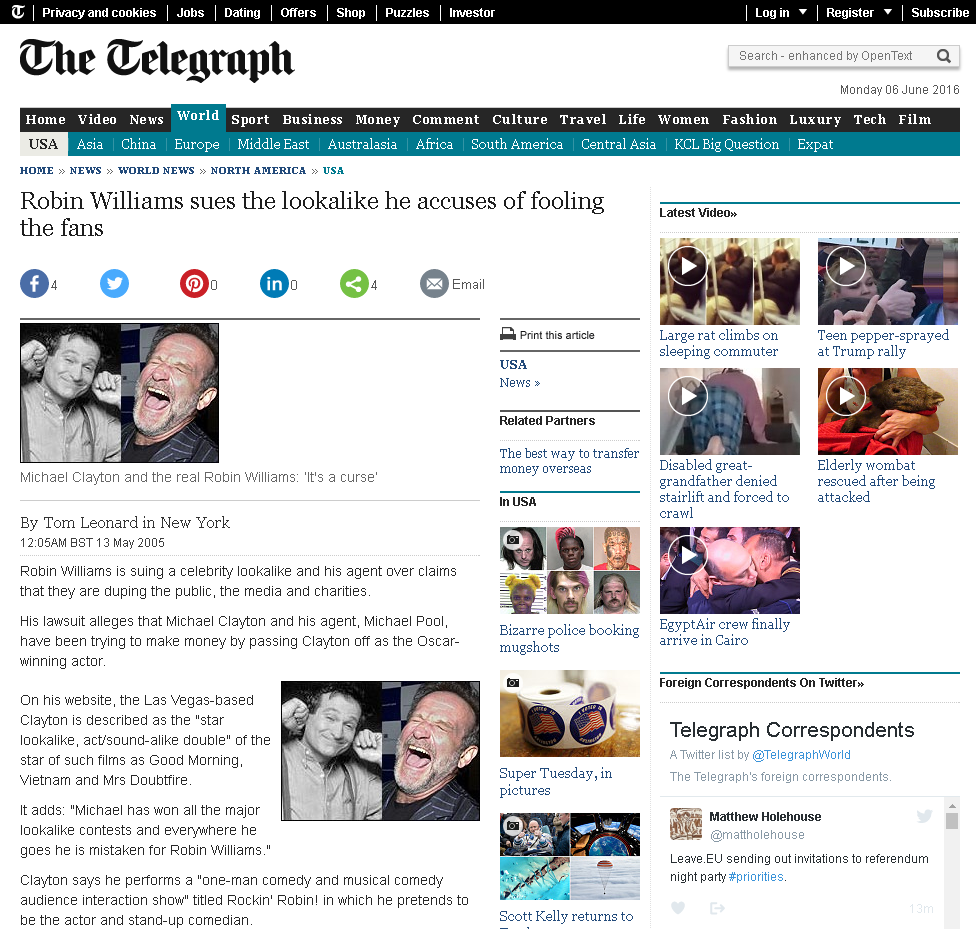
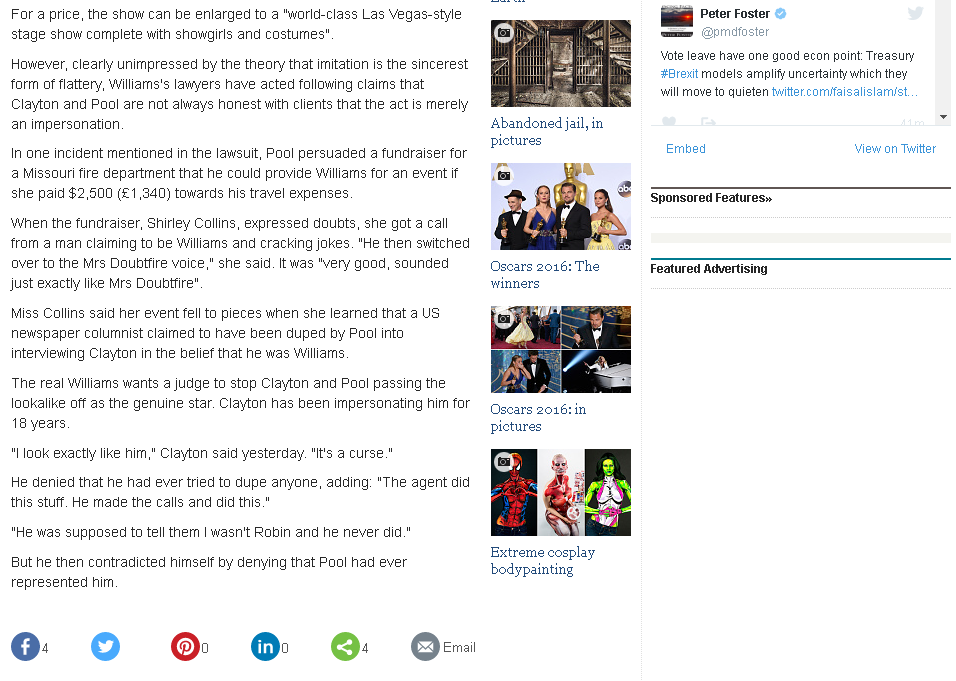
Scenario -
You are a showbiz journalist and have been given a good tip by a reliable contact that an A-list celebrity is having a secret relationship with a married Premiership footballer. How would the legal term of libel (defamation) apply and what legal aspects would you have to take into consideration before your story is published?
Definition of Libel -
The legally indefensible publication or broadcast of words or images that are degrading a person or injurious to his or her reputation.
Answer to the scenario -
A big thing for the news is always to only publish and present what is complete fact, this is important because libel can take into affect here. Even if it is the truth, you must back it up, have an official statement and make a story on it after it has happened. You aren't allowed to make a story on the something which is based on speculation as that wouldn't be classified as news. For harmless topics this can be allowed but wouldn't be published from any big producer of the news today.
In this case, we are dealing with something highly controversial and also something which could be damaging to the reputation of both parties involved. This is why I mentioned that its important not to report on speculation or something which might not be completely true. Often though, you will see gossip magazines and such report on a story like this after its already happened and been made public by someone directly involved.
Avoiding breaking the law by not publishing a story based speculation is not only good journalistic practice but also keeps you and your company from being under fire and sued for millions potentially. This is the exact same in how a journalist should only report what is complete fact, lying will only get everyone into trouble as well as anyone else who may use that piece of information. Even if they quote you in and say where the information you got was sourced.
Task 2:
For task two I found a website in which went over some of the not only most well know cases of libel but also successful, the full site can be found here as its an interesting read: http://www.insidecounsel.com/2014/11/18/6-most-successful-celebrity-libel-and-slander-case?slreturn=1465232280
In specific, I want to focus on the 2nd story written here as its the one that stands out to me the most.
So what happened?
A look-alike of Robin Williams and his agent were pretending to be the actual Robin Williams where the look-alike was actually cheating charities under the name of Robin Williams. In turn this caused a lot of damage to Robin Williams' name and reputation.
Another article on the matter can be found here in which the Telegraph took their take on the turn of events:
http://www.telegraph.co.uk/news/worldnews/northamerica/usa/1489946/Robin-Williams-sues-the-lookalike-he-accuses-of-fooling-the-fans.html
The story pasted here -
My findings -
From this article we get to follow the story of Robin Williams and his proceedings in suing the look-alike of him who cheated charities and in Robins words, fooled the fans.
It's also important to point out this article underlines how serious this issue is and how its dealt with and same with the other article posted above, its not the only time defamation has happened, this has happened a lot.
Task 3:
Scenario -
you are about to publish an online book, via Kindle, which is your own creation. Why would the law of UK Copyright be so significant?
Answer to the scenario -
From this article we get to follow the story of Robin Williams and his proceedings in suing the look-alike of him who cheated charities and in Robins words, fooled the fans.
It's also important to point out this article underlines how serious this issue is and how its dealt with and same with the other article posted above, its not the only time defamation has happened, this has happened a lot.
Task 3:
Scenario -
you are about to publish an online book, via Kindle, which is your own creation. Why would the law of UK Copyright be so significant?
Answer to the scenario -
Copyright
when publishing anything anywhere is always an underlying factor.
In this
scenario, we’ll be publishing a book online to Kindle. Copyright comes in
extremely helpful here as often, online, it is common that a lot of things can
be illegally downloaded or plagiarised with little consequences because of it.
There’s a certain level of anonymity in which a person can hide behind when
online and it is abused every minute.
Because of
this, you want to stay clear of copyright laws and not fall under receiving
legal action taken against you. Everything in your book should be your original
and own content. If it is sourced from somewhere, it should be your own words
with references made to where you sourced the information at the end of the
book. Plagiarising is against the law and you will be breaking copyright laws
by failing to not put your own writing into it.
Unfortunately,
it doesn’t end there for copyright. On top of this, another part of copyright
that you have to abide by is having a unique title for your book. This is
important in particular because like how you can’t make your own drink and name
it Coca-Cola, you can’t produce a book and call it James and the Giant Peach.
It has to be your own and original.
Copyright
is a form of intellectual property, and so by staying in line with the law of
copyright, your own worked will be protected as well as not being in trouble
with others and the work they have produced.
So assuming
all of the content of your book is completely yours unless sourced correctly
and produced for educational use with the consent of the original author, as
well as the title of your book is your own, everything should be in check. Your
book after meeting all these requirements will then be able to be published if
Kindle decides to take on your book and feature it in their library.
If you
violate copyright law, you can and will be given a fine or complete rejection
from whoever you are trying to get to publish your book. Even if a publisher
takes on your book and it is then produced and sold, you can’t still get into
legal trouble, as well as the publisher.
Cases where
the original publisher of whose work you’ve copied finds out and then decides
to threat legal action against you or even take you straight to court to sue
you for copyright can still happen and its not extremely uncommon. Copyright infringement
happens often in todays world, especially in publishing and media creation.
Phone-hacking
Definition of phone hacking –
Phone hacking is where someone gains access to your data stored on your phone by unauthorized means. This is done in order to access someone’s voicemail especially, though still illegal.
Two online
stories about celebrities which have been phone hacked –
Story 1
The full
stories pasted here:

The common theme within this article which follows throughout is the statistics and figures of how much people are receiving in compensation because of their phones being hacked into. This covers the aftermath of the phone hacking in particular compared to a story which has been produced because of the phone hacking. Presenting the statistics of how much people have been given in compensation keeps the article and ball rolling. It gives the article a way to stay interesting and gives the reader questions of who else received what? and makes the reader inclined to keep reading.
Another thing which this article does is explain the thoughts and feelings of various people who were a victim of the phone hacking. Powerful quotes like “Nothing can take away or repair the damage that was caused to me both personally and professionally and the impact it had on my friends, family and relationships at that time. The damages although welcome can never repair the hurt that was caused.” are used because the reader is then able to feel empathetic or sympathy for that person if they wish to and also leave the reader to form their own opinion based on the person involved.
In the article further implications are presented as well as in the form of this paragraph: "However, with the company now facing new phone-hacking damages claims from more than 100 high-profile figures, it also said it was increasing the amount of money set aside to deal with the legal cases from £12m to £28m."
The further report on the accusations that there may be even more to this story that meets the eye, opens up to possible progression on the story and continuation of the story.
Another thing which this article does is explain the thoughts and feelings of various people who were a victim of the phone hacking. Powerful quotes like “Nothing can take away or repair the damage that was caused to me both personally and professionally and the impact it had on my friends, family and relationships at that time. The damages although welcome can never repair the hurt that was caused.” are used because the reader is then able to feel empathetic or sympathy for that person if they wish to and also leave the reader to form their own opinion based on the person involved.
In the article further implications are presented as well as in the form of this paragraph: "However, with the company now facing new phone-hacking damages claims from more than 100 high-profile figures, it also said it was increasing the amount of money set aside to deal with the legal cases from £12m to £28m."
The further report on the accusations that there may be even more to this story that meets the eye, opens up to possible progression on the story and continuation of the story.
Analysis of story 2 -
In our second story I searched for a story on phone hacking with a different theme to the first one, I did this because I wanted to cover how different stories are not only covered by different news websites but also how the story is reported in the views of the victims and now in views of reporting on someone who is being jailed for it.
The story itself covers the happenings of a former News of the World Editor who has been jailed for 18 months. It also covers the story further by breaking it up into four subheadings, "Intensely Personal", "In court", "The lucky one" and "Stronger person". Each category acts as a way to split up the large article in a way which can be easily read. Some are straight forward like "In court" whilst others only vaguely hint and give an idea to the contents of that paragraph, like "The lucky one.
Like the other article, statistics and statements are present which keep the reader inclined to reading as well as allow their own opinion to be informed whilst the news remains neutral. Quotes are also present in the article and are an integral part of any online news stories. These quotes, such as, "Asked about the jailing of his former communications chief, the prime minister, who has apologised for hiring him, said: "What it says is that it's right that justice should be done and that no one is above the law - as I've always said."" are essential to an article such as this and in this case start off one of the subheadings in this article nicely.
A report on comparing newspapers
For this task I am comparing different news papers which all cover the same story. My reasoning for this is to see how much space is devoted to the story, how many journalists are working on the story, if the paper has a strong opinion on the subject of the story as well as other things like where in the paper is it featured? For example, is it on the front page or somewhere else?

Again like my last website I looked at this story, the fact its featured on the homepage and is the second article featured on the site, shows off its importance and reveals to the viewer that a new instalment as well as more information on the story has come out. There isn’t much to say about its placement that hasn’t already been said to be honest, so on that note I will move onto other parts of the article.
Does the website/newspaper have a strong opinion or bias?
Much like The Guardian, the BBC is a very professional and reputable news outlet which brings you the news at a high standard which isn’t filled with logical fallacies or opinionated views by the journalist. In the article, a mature and educated view is given on the subject where everything is kept to a neutral stand point in order to deliver the news professionally.
One thing the BBC does do different to The Guardian is the headline, in The Guardians headline, simple language is used to appeal to all readers as well be understandable by viewers of a lower reading skill or age. Where as in the article from the BBC, more sophisticated language is employed as well as buzzwords too which captivate and draw in the viewer but remain at a higher intellectual standpoint in the headline; Junior doctors' dispute: Proposal aimed at breaking deadlock.
Is the content of the article interesting?
Personally, I think the content of the article is interesting but I can see where others would feel otherwise and fall short. The language and writing used remains in a simply constructed way but with short sentences and quotes but what stand out and puts it apart from the rest is the actual language and writing inside.
Inside the article the writing remains like the title, a sophisticated way of thinking and developing the story as the article goes on is used in the quotes given and to cater to their audience of people who read. My main point here is that The Guardian catches the attention of a younger audience of people who are young adults or teenagers as well as adults so the language is simpler but BBC News has a much more mature and older audience and so the stories written for the site are written in a way which appeals to someone of more maturity and intelligence.

What this says to be is that I don’t think the mirror felt this story was as important as others, especially two after being published and since then, no update on the current affairs of junior doctors has been made. Because of this, it has led me to believe that the mirrors viewer base and readers cares less about this subject as compared to that of The Guardian or BBC News.
Does the website/newspaper have a strong opinion or bias?
Yes, I think this article has a strong opinion on the subject and bias. My reasoning for this is in the headline itself; Jeremy Hunt's fight with junior doctors exposed by his own department as 'a castle built on sand’. This headline puts Jeremy Hunt under fire and shows a clean bias where The Mirror is in favour of the junior doctors on strike.
Despite this, I still think the journalist who has written the article has kept to neutral stand point as best as possible like someone who writes for a news company should do. Someone who writes with an opinionated bias and their thoughts is not a news article but more of a blog on their views on the subject. This article falls into that from the headline to draw people in but then returns to a professional standard of writing afterwards once it gets into the actual article.
Is the content of the article interesting?
The content of this article is interesting to me because it features and covers a controversial topic as well as features quotes from people who feel strongly about the topic and are affected by it.
“Shadow Health Secretary Heidi Alexander added: “Jeremy Hunt has wasted most of the last year picking a fight with junior doctors by claiming his new contract would deliver a seven-day NHS.”” Is interesting because the information you get from the quote gives a bigger picture to the issue as well as expands on the story and article thus far.
Another point in which makes the article interesting is because the article features a lot of images which help add to the initial headline and supporting text of the article. What I noticed with the other articles I looked at from different sites is that the articles have some pictures to support the information provided but The Mirror incorporates the most images as well as features a poll at the end asking for the public and any viewers to give fourth their input.

Written by – Steven Swinford, deputy political editor
For my fourth article I am featuring the on-going story developed by The Telegraph. The article itself isn’t featured on the front page and to find this article I had to do a google search of “telegraph junior doctors’” and the result is the fifth one down.

This is evidence of the article being the fifth one down on the google search and shows how important this news is to the readers as even older articles and stories reported on the on-going affair are above the latest information of the story.
Does the website/newspaper have a strong opinion or bias?
From reading this article I don’t think The Telegraph or the writer has a strong opinion towards or against the situation at hand. This is a good thing because as like I’ve repeated throughout the whole of this documents, the point of a news story is to remain a neutral standpoint and deliver the news whilst informing and giving the reader/viewer both sides of the argument if needed and leaving their opinions and thoughts behind.
I think what this article does best is explore the thoughts and feelings of those involved and not just displaying someone with a sign up but by videos of people like Jeremy Hunt and David Cameron.

Is the content of the article interesting?
The article displays a lot of statistics and information on what junior doctors do and earn as well as information on safe-working which no other article as done. This is completely unique to every other article I have looked at and really stands out and help with the closing of the story. It’s additional information which is completely optional but will help strength or create a bigger understanding of how the reader feels by the end of it.
Going back to the point I made earlier about video clips, this is another unique selling point of The Telegraph’s article. No other article I have looked at so far has done this and it really helps the article a lot. This and coupled being coupled with the basic level of English used so more people can understand it makes the article for me at least the best one to read and continue wanting to read on.
My chosen story –
My chosen story is about the junior doctors current issue and affair which is on-going in the UK. Today, printed in the papers and published online is the next instalment of this developing story where the Junior doctors have agreed to have a temporary halt to strikes in exchange for talks where a new contract may finally resolve the whole dispute.Newspaper 1: The Guardian
Story found here – http://www.theguardian.com/society/2016/may/04/junior-doctors-agree-temporary-halt-to-strikes-in-exchange-for-talks
Written by – Denis Campbell, Health policy editor
My first chosen newspaper/news outlet is The Guardian. This is where I found the story initially and where I then went and branched off onto other websites that provide news. I found the story first because on the front page the story is displayed close to the top right of all the front page articles.

This screenshot shows evidence of the article being at the top of the page and just below the weather. Because the article is put at the top of the website, to the side of the news about polls opening in the UK, this means that the contents and what the subject is about is important. I think this is justified because the affair is on-going and current, on top of this I also think its justified because this brings new light into the story and carries on the development of older stories made on the story.
Does the website/newspaper have a strong opinion or bias?
The newspaper itself doesn’t show to have a strong opinion either for or against the protesting but remains a neutral stand point in which quotes are used to help create a bigger picture and inform the reader of the situation. This is good because a news papers job is to present the news and inform people of issues around the world right now. Social bias and the bias of the journalist itself should be kept clear from the papers as that will deviate from the actual purpose of what a newspaper is itself.
More proof of the article by The Guardian remains at a neutral standpoint on the situation is in the the headline; “Junior doctors agree to temporary halt to strikes in exchange for talks”. The headline used and created for the article remains neutral and doesn’t lean to any side of opinion.
Is the content of the article interesting?
The Guardians article on this story has interesting information to say the least as the story is filled with quotes from reputable sources such as Prof Simon Wessely, the president of the Royal College of Psychiatrists and also gives insight into both sides of the story. It’s structured in a way that keeps you reading and progress the situation in your head step by step till the end which leaves you after reading it all, feeling fulfilled and understanding of the topic.
Written by – Hugh Pym, Health Editor
My second chosen website/newspaper to look at is none other than BBC News. I chose to look at this website next for my comparison between newspapers because I was familiar with the website and knew the story would be featured on this site without question.
On the website of BBC News, the article itself is presented as the second article on the homepage just below the news of election day which seems to be a popular theme so far. Evidence of the story being just under the first article of the homepage is seen here:
Written by – Denis Campbell, Health policy editor
My first chosen newspaper/news outlet is The Guardian. This is where I found the story initially and where I then went and branched off onto other websites that provide news. I found the story first because on the front page the story is displayed close to the top right of all the front page articles.

This screenshot shows evidence of the article being at the top of the page and just below the weather. Because the article is put at the top of the website, to the side of the news about polls opening in the UK, this means that the contents and what the subject is about is important. I think this is justified because the affair is on-going and current, on top of this I also think its justified because this brings new light into the story and carries on the development of older stories made on the story.
Does the website/newspaper have a strong opinion or bias?
The newspaper itself doesn’t show to have a strong opinion either for or against the protesting but remains a neutral stand point in which quotes are used to help create a bigger picture and inform the reader of the situation. This is good because a news papers job is to present the news and inform people of issues around the world right now. Social bias and the bias of the journalist itself should be kept clear from the papers as that will deviate from the actual purpose of what a newspaper is itself.
More proof of the article by The Guardian remains at a neutral standpoint on the situation is in the the headline; “Junior doctors agree to temporary halt to strikes in exchange for talks”. The headline used and created for the article remains neutral and doesn’t lean to any side of opinion.
Is the content of the article interesting?
The Guardians article on this story has interesting information to say the least as the story is filled with quotes from reputable sources such as Prof Simon Wessely, the president of the Royal College of Psychiatrists and also gives insight into both sides of the story. It’s structured in a way that keeps you reading and progress the situation in your head step by step till the end which leaves you after reading it all, feeling fulfilled and understanding of the topic.
Newspaper 2: BBC News
Story found here – http://www.bbc.co.uk/news/health-36209321Written by – Hugh Pym, Health Editor
My second chosen website/newspaper to look at is none other than BBC News. I chose to look at this website next for my comparison between newspapers because I was familiar with the website and knew the story would be featured on this site without question.
On the website of BBC News, the article itself is presented as the second article on the homepage just below the news of election day which seems to be a popular theme so far. Evidence of the story being just under the first article of the homepage is seen here:

Does the website/newspaper have a strong opinion or bias?
Much like The Guardian, the BBC is a very professional and reputable news outlet which brings you the news at a high standard which isn’t filled with logical fallacies or opinionated views by the journalist. In the article, a mature and educated view is given on the subject where everything is kept to a neutral stand point in order to deliver the news professionally.
One thing the BBC does do different to The Guardian is the headline, in The Guardians headline, simple language is used to appeal to all readers as well be understandable by viewers of a lower reading skill or age. Where as in the article from the BBC, more sophisticated language is employed as well as buzzwords too which captivate and draw in the viewer but remain at a higher intellectual standpoint in the headline; Junior doctors' dispute: Proposal aimed at breaking deadlock.
Is the content of the article interesting?
Personally, I think the content of the article is interesting but I can see where others would feel otherwise and fall short. The language and writing used remains in a simply constructed way but with short sentences and quotes but what stand out and puts it apart from the rest is the actual language and writing inside.
Inside the article the writing remains like the title, a sophisticated way of thinking and developing the story as the article goes on is used in the quotes given and to cater to their audience of people who read. My main point here is that The Guardian catches the attention of a younger audience of people who are young adults or teenagers as well as adults so the language is simpler but BBC News has a much more mature and older audience and so the stories written for the site are written in a way which appeals to someone of more maturity and intelligence.
Newspaper 3: The Mirror
Story found here – http://www.mirror.co.uk/news/uk-news/jeremy-hunts-fight-junior-doctors-7890253
Written by – Dan Bloom
The Mirror features a different side of the story which is intended to blast Jeremy Hunt for what he has done instead of covering the news about the talks which are in exchange. This is completely different to the story of which The Guardian and the BBC featured. And also features a bias of which I will go into more later on.
To find this article, I had to go through a lot more as it wasn’t present on the front page of the website. To find this article I actually had to google “The Mirror junior doctors” as seen here:
Written by – Dan Bloom
The Mirror features a different side of the story which is intended to blast Jeremy Hunt for what he has done instead of covering the news about the talks which are in exchange. This is completely different to the story of which The Guardian and the BBC featured. And also features a bias of which I will go into more later on.
To find this article, I had to go through a lot more as it wasn’t present on the front page of the website. To find this article I actually had to google “The Mirror junior doctors” as seen here:

Does the website/newspaper have a strong opinion or bias?
Yes, I think this article has a strong opinion on the subject and bias. My reasoning for this is in the headline itself; Jeremy Hunt's fight with junior doctors exposed by his own department as 'a castle built on sand’. This headline puts Jeremy Hunt under fire and shows a clean bias where The Mirror is in favour of the junior doctors on strike.
Despite this, I still think the journalist who has written the article has kept to neutral stand point as best as possible like someone who writes for a news company should do. Someone who writes with an opinionated bias and their thoughts is not a news article but more of a blog on their views on the subject. This article falls into that from the headline to draw people in but then returns to a professional standard of writing afterwards once it gets into the actual article.
Is the content of the article interesting?
The content of this article is interesting to me because it features and covers a controversial topic as well as features quotes from people who feel strongly about the topic and are affected by it.
“Shadow Health Secretary Heidi Alexander added: “Jeremy Hunt has wasted most of the last year picking a fight with junior doctors by claiming his new contract would deliver a seven-day NHS.”” Is interesting because the information you get from the quote gives a bigger picture to the issue as well as expands on the story and article thus far.
Another point in which makes the article interesting is because the article features a lot of images which help add to the initial headline and supporting text of the article. What I noticed with the other articles I looked at from different sites is that the articles have some pictures to support the information provided but The Mirror incorporates the most images as well as features a poll at the end asking for the public and any viewers to give fourth their input.

Newspaper 4: The Telegraph
Story found here – http://www.telegraph.co.uk/news/2016/05/02/doctors/Written by – Steven Swinford, deputy political editor
For my fourth article I am featuring the on-going story developed by The Telegraph. The article itself isn’t featured on the front page and to find this article I had to do a google search of “telegraph junior doctors’” and the result is the fifth one down.

Does the website/newspaper have a strong opinion or bias?
From reading this article I don’t think The Telegraph or the writer has a strong opinion towards or against the situation at hand. This is a good thing because as like I’ve repeated throughout the whole of this documents, the point of a news story is to remain a neutral standpoint and deliver the news whilst informing and giving the reader/viewer both sides of the argument if needed and leaving their opinions and thoughts behind.
I think what this article does best is explore the thoughts and feelings of those involved and not just displaying someone with a sign up but by videos of people like Jeremy Hunt and David Cameron.

The article displays a lot of statistics and information on what junior doctors do and earn as well as information on safe-working which no other article as done. This is completely unique to every other article I have looked at and really stands out and help with the closing of the story. It’s additional information which is completely optional but will help strength or create a bigger understanding of how the reader feels by the end of it.
Going back to the point I made earlier about video clips, this is another unique selling point of The Telegraph’s article. No other article I have looked at so far has done this and it really helps the article a lot. This and coupled being coupled with the basic level of English used so more people can understand it makes the article for me at least the best one to read and continue wanting to read on.
CVs and Job applications
A CV and Job Application are two very important and essential things you'll need when applying for a job or presenting your services to somewhere. In particular a CV will give the employer an interest into who you are as a person as well as all of your previous achievements and grades from school, college and beyond that.
It also lets the employer know what type of person you are and where your abilities stand. On the CV there will also be a list to your contact information as well as references in which the employer can contact should they want to find out more about you as a person and how you work. It is important to also list previous work experience and why you left that job as well.
A CV must contain:
In terms of a Job Application, its a little different by may be accompanied by your CV when provided. The job application is what it says on the tin pretty much. Its an application towards the job you want to work at. Job applications should contain specific information about the place you'll be working at, as well as why you want to work there and why you think you're right for the job.
Job applications are almost an extended version of a CV where you can go into detail about the reasons behind why you applied and were interested in the job in the first place.
To recap on Job Applications -
It also lets the employer know what type of person you are and where your abilities stand. On the CV there will also be a list to your contact information as well as references in which the employer can contact should they want to find out more about you as a person and how you work. It is important to also list previous work experience and why you left that job as well.
A CV must contain:
- Personal details - Name, address/es, telephone and mobile numbers, email address/es
- Depending on your circumstances the following may also be required: date of birth, nationality, gender or place of birth
- Qualifications - Anything from Secondary school and after that- this should be in reverse chronological order and more space should be given to qualifications which matter most. Usually a degree from University.
- Relevant skills - Include the skills that you have which you think the employer is looking for. After that, put details about how you learnt those skills, what course did you use them in or where in previous work did them as well as include some information on your interests.
- Work Experience - Any situation in which you were working is allowed to be put on your CV, this includes paid and unpaid work as well as voluntary work. This can tie into your relevant skills section, certain skills you may have learnt can be tied back to the previous instance of work and show experience of which you have developed to the employer.
- Interests - Avoid listing all of your interests but focus on a select few, for example if you are involved with sports and like playing sports, that can show off your team working ability and let the employer know you're capable of working in a team. It's all about listing an interest which is suitable and relevant to the skills you have learnt relative to what your employer is looking for.
- Referees - Normally you will be required to put two people down as a reference. A reference is there so that the employer if they wish to can contact that person and find out more about how you work and what skills you have. Usually someone like a previous tutor or other form of academic referee is used for at least one reference.You should not use family members as a reference and always ask for permission beforehand.
In terms of a Job Application, its a little different by may be accompanied by your CV when provided. The job application is what it says on the tin pretty much. Its an application towards the job you want to work at. Job applications should contain specific information about the place you'll be working at, as well as why you want to work there and why you think you're right for the job.
Job applications are almost an extended version of a CV where you can go into detail about the reasons behind why you applied and were interested in the job in the first place.
To recap on Job Applications -
- They cover: Your personal details
- Employment history
- Educational history
- Reasons why you're suitable for the job
- References
Comparing the way news was told 1954 - 2004
Comparing the process of news from 1954 - 1963
News throughout the decades has changed immensely. From using the radio to the invention of the television as well as the technological advancements made in todays world.
In 1954 to 1963, the BBC started to switch from presenting the news on the radio onto the TV. It started with a news conference every morning where such questions like "What will be filmed?" and "Why will it be filmed?" are answered.
The plans will then be turned into pictures. Camera men and crews go out onto location to film the content that they need. This can even be done abroad and the crews are all set out to different locations to all film stuff individually. Eventually, everything is relayed back to the labs in London for processing.
Once the news has been processed, it is then returned and shipped to the editors back at the office. The editors cut the negative and dispose of whats not needed. This part is crucial, so every foot of the film is checked so that the accepted pieces will be able to be joined together.
Writers are then proposed to write a script, its important that the image is already near its finishing stage as the writers will have to watch the footage page and come up with a script based around it. The sound team also have a part to play whilst the editors come to finishing up attaching all the film back to each other. In particular, the sound team assembles the music or other pieces of sound which need to accompany the film, as the film doesn't actually record the sound at his point in history.
Everyone starts to come together as the commentators are against the clock. Sound and projection then come together to create the news.
This is the process of the news in 1954 but by the time of the 1960s the process had changed considerably. The main process of creating the news is still the same but there are subtle differences made. For example, in the 1960s, presenters started to become known by the public. Before the 1960s this wasn't a thing as the presenters identity was kept from the public audience.
Another difference is that agencies would now supply news on film worldwide. This means that not everyone producing work for BBC news was actually under the company, it also meant that world news became a thing and reporting on happenings and affairs world wide were achieved.
My last difference I will list is to do with the fact that news flashes also became a thing in the 1960s, much like the identity of the presenters. The news flashes would be radioed in and lead to being able to give a constant update on any news previously reported or if anything big happens whilst the news is being reported.
Aside from all this, no much else is different about the news from 1954 to 1963, the process is still the same just improvements were made in how it is presented and we became more capable of giving news on the spot via radio whilst still presenting normally via film.
Comparing the news from 1954 and 1963 to 1994 and 2004
In 2004 news had changed a lot and technology had improved vastly as it still continues to do. Some similarities remain though. Each morning the Editor runs through with everyone involved of the program ahead that following day, just the same as in the 1950s and 60s.
A significant difference here though is that the production had a news desk, the news desks role is to go through camera crews and inform everyone of the locations where recording is needed. Instead of there being one editor, there is a team of editors which all are chaired for a meeting to go through the video and film because being put on air.
There isn't anything much different from today to back then other than the changes listed in production above. The last difference is the speed in which news over abroad can reach the news station. Instead of the reels of film having to be dispatched back to the lab, satellites in the satellite coordination room take in all of the information and stories done from across the world.
News throughout the decades has changed immensely. From using the radio to the invention of the television as well as the technological advancements made in todays world.
In 1954 to 1963, the BBC started to switch from presenting the news on the radio onto the TV. It started with a news conference every morning where such questions like "What will be filmed?" and "Why will it be filmed?" are answered.
The plans will then be turned into pictures. Camera men and crews go out onto location to film the content that they need. This can even be done abroad and the crews are all set out to different locations to all film stuff individually. Eventually, everything is relayed back to the labs in London for processing.
Once the news has been processed, it is then returned and shipped to the editors back at the office. The editors cut the negative and dispose of whats not needed. This part is crucial, so every foot of the film is checked so that the accepted pieces will be able to be joined together.
Writers are then proposed to write a script, its important that the image is already near its finishing stage as the writers will have to watch the footage page and come up with a script based around it. The sound team also have a part to play whilst the editors come to finishing up attaching all the film back to each other. In particular, the sound team assembles the music or other pieces of sound which need to accompany the film, as the film doesn't actually record the sound at his point in history.
Everyone starts to come together as the commentators are against the clock. Sound and projection then come together to create the news.
This is the process of the news in 1954 but by the time of the 1960s the process had changed considerably. The main process of creating the news is still the same but there are subtle differences made. For example, in the 1960s, presenters started to become known by the public. Before the 1960s this wasn't a thing as the presenters identity was kept from the public audience.
Another difference is that agencies would now supply news on film worldwide. This means that not everyone producing work for BBC news was actually under the company, it also meant that world news became a thing and reporting on happenings and affairs world wide were achieved.
My last difference I will list is to do with the fact that news flashes also became a thing in the 1960s, much like the identity of the presenters. The news flashes would be radioed in and lead to being able to give a constant update on any news previously reported or if anything big happens whilst the news is being reported.
Aside from all this, no much else is different about the news from 1954 to 1963, the process is still the same just improvements were made in how it is presented and we became more capable of giving news on the spot via radio whilst still presenting normally via film.
Comparing the news from 1954 and 1963 to 1994 and 2004
In 2004 news had changed a lot and technology had improved vastly as it still continues to do. Some similarities remain though. Each morning the Editor runs through with everyone involved of the program ahead that following day, just the same as in the 1950s and 60s.
A significant difference here though is that the production had a news desk, the news desks role is to go through camera crews and inform everyone of the locations where recording is needed. Instead of there being one editor, there is a team of editors which all are chaired for a meeting to go through the video and film because being put on air.
There isn't anything much different from today to back then other than the changes listed in production above. The last difference is the speed in which news over abroad can reach the news station. Instead of the reels of film having to be dispatched back to the lab, satellites in the satellite coordination room take in all of the information and stories done from across the world.
The Production Process of A Newspaper
Newspapers are produced differently to how they are now, but the process in which they undergo is the same. Before in the past, you would have to print the paper by using a movable type press first invented by Johannes Gutenberg. The movable type press was first invented in 1040.
Now it’s much simpler where we have printers which can mass produce the news papers. The process in which a newspaper or magazine follows in order to become complete is as follows:
Step 1: News/Story gathering
The production starts with reporters going out to find and gather stories, this is done by covering events or creating and gathering information for a follow up story. Once the reporter gets their stories together, the editor of that news paper or magazine will receive each one via email. This is done daily. In addition to this, each reporter and journalist has their own particular desk in the news room. For example, some one at the political desk would be gathering info and writing up a story based around political views, or say a sports desk, the person working there would be writing stories based on sports.
Once stories have been gathered the sub editors are then put into gear with the responsibility of editing the copies which have been submitted by the reporter. A red pen or red font is used to show what edits that’s have made, the Chief sub editor uses a blue pen/font to identify what edits they have made and the lead editor of the whole product uses green.
Step 2: Pre Press
The pre press process of a newspaper or magazine comes after all of the story gathering has been complete. Because of the advancement of technology over time, its important publishing industries keep up to date with the latest technological trends which is why a lot of the also have a website which produces work alongside a physical printed copy. An advantage of having a website which also delivers news is because more stories can be added on in real-time and existing stories can be updated on the go.
In the pre press stage, different pages of the site are laid out and designed, this is the planning before putting content on the pages and advertisements that will be featured will also forwarded by the marketing team where places or specific pages will be used for their advertisement. Once all of the pages have been laid out, a dummy sheet is created to give a look at what the final product would be. In this stage, all of the text, pictures, cutline, graphics and graphical illustrations as well as colour is put together and the dummy sheets are transformed into an approved digital form by the editorial department.
Step 3: Press
Press can be broken into two different parts, the Lithographic stage and the Impression stage. Newspapers which are more sophisticated use a certain technology called CTP. CTP means Computer to Plate whilst some use CTM (Computer to Machine). So what are CTP and CTM?
Lithographic Stage –
The lithographic stage is where all of the content and stories along side advertisements are taken to the lithographic section. This is where everything is registered on a plate. The plate itself is an aluminium-like iron sheet in the size of the newspaper (A3) and is then used to run the printing of the newspaper on the printing machine. A CTP machine registers the already designed information at the pre press on the plate. The plate is fixed on the machine to run impression.
Impression Stage –
The impression stage is where the final product comes out. Thousands of copies are printed and to be given all over newspaper’s covered areas. The plates are hung on the printing machine where numerous copies are printed out to be circulated and sold to readers.
An important thing to note is that the newspapers are designed and get produced a day before the publishing day, this covers both the current pages and advanced pages.
Step 4: Post Press
Post Press is the circulation of all the printed copies which are delivered all across the nation and to different centers in which distribute it all over the country.
Now it’s much simpler where we have printers which can mass produce the news papers. The process in which a newspaper or magazine follows in order to become complete is as follows:
Step 1: News/Story gathering
The production starts with reporters going out to find and gather stories, this is done by covering events or creating and gathering information for a follow up story. Once the reporter gets their stories together, the editor of that news paper or magazine will receive each one via email. This is done daily. In addition to this, each reporter and journalist has their own particular desk in the news room. For example, some one at the political desk would be gathering info and writing up a story based around political views, or say a sports desk, the person working there would be writing stories based on sports.
Once stories have been gathered the sub editors are then put into gear with the responsibility of editing the copies which have been submitted by the reporter. A red pen or red font is used to show what edits that’s have made, the Chief sub editor uses a blue pen/font to identify what edits they have made and the lead editor of the whole product uses green.
Step 2: Pre Press
The pre press process of a newspaper or magazine comes after all of the story gathering has been complete. Because of the advancement of technology over time, its important publishing industries keep up to date with the latest technological trends which is why a lot of the also have a website which produces work alongside a physical printed copy. An advantage of having a website which also delivers news is because more stories can be added on in real-time and existing stories can be updated on the go.
In the pre press stage, different pages of the site are laid out and designed, this is the planning before putting content on the pages and advertisements that will be featured will also forwarded by the marketing team where places or specific pages will be used for their advertisement. Once all of the pages have been laid out, a dummy sheet is created to give a look at what the final product would be. In this stage, all of the text, pictures, cutline, graphics and graphical illustrations as well as colour is put together and the dummy sheets are transformed into an approved digital form by the editorial department.
Step 3: Press
Press can be broken into two different parts, the Lithographic stage and the Impression stage. Newspapers which are more sophisticated use a certain technology called CTP. CTP means Computer to Plate whilst some use CTM (Computer to Machine). So what are CTP and CTM?
Lithographic Stage –
The lithographic stage is where all of the content and stories along side advertisements are taken to the lithographic section. This is where everything is registered on a plate. The plate itself is an aluminium-like iron sheet in the size of the newspaper (A3) and is then used to run the printing of the newspaper on the printing machine. A CTP machine registers the already designed information at the pre press on the plate. The plate is fixed on the machine to run impression.
Impression Stage –
The impression stage is where the final product comes out. Thousands of copies are printed and to be given all over newspaper’s covered areas. The plates are hung on the printing machine where numerous copies are printed out to be circulated and sold to readers.
An important thing to note is that the newspapers are designed and get produced a day before the publishing day, this covers both the current pages and advanced pages.
Step 4: Post Press
Post Press is the circulation of all the printed copies which are delivered all across the nation and to different centers in which distribute it all over the country.
Interviewing an industry professional
Pre-planning to interview an industry professional
Research somebody who works in that role
SHOW:
- Examples of their work
- 10 questions of which you will email to the person
- Provide evidence by showing emails as well as the answers & replies
Alternative – Chief Editor via email found below
Contact Information –
Twitter: @Mark_Lynas
Email to National Geographic: ngsforum@nationalgeographic.com
Questions to ask –
1. Is time management important in a job like yours?
2. What equipment is required in order to fulfil tasks set?
3. What kind of entry requirements are there for a job such as your own?
4. How much knowledge and understanding of the job role is needed to perform tasks set effectively?
5. What is the location of which you work in? – In an office/offsite?
6. What qualifications and work experience do you have and do you think they have helped you in your field of work?
7. How long are the working hours you take in each week?
8. Is the ability of working with others something you need, or is it possible to do your job alone?
9. What kind of employment contract do you work under and what can someone wishing to do this job this job expect in terms of contracts?
10. What is the basic salary you typically earn for a job such as your own?
The results of the interview
1) Time keeping is essential in any job but as a writer where you’re constantly having to come up with something this all comes together a lot more. The National Geographic Magazine isn’t published everyday like a newspaper and the work you have been doing is done but its still important as you need to meet deadlines when set, wherever you are or whatever you work for.
2) Generally the equipment needed for a writer is pretty standard. A computer alongside other things as a notepad, pen and paper are all needed. If I find out information whilst out and on the go, I can easily write it down and relay that information for later use. In terms of the pre-production to producing a story, evidence of phone calls and recordings of things that have been said also provide as an invaluable source for a writer. Especially one that writes about current events and happenings in the world.
3) Well first of all, the ability to write and be fluent in English is a given. Aside from that there are no real qualifications that are required but such things as doing a course in journalism or a communications and media studies course will definitely help your chances. The key set of skills you can have for a job like this is to be able to write well and be understanding of what the target audience likes to see and is easy to read for them.
4) This is a lot similar to the previous question, to be a writer you need to be talented in what you do. Have a strong mental attitude towards your work and don’t entirely push yourself beyond the limits of what you enjoy but also don’t forget you may have deadlines to which you have to meet. A good understanding of the English language and appropriate writing skills are your best bet when it comes to knowledge and understanding of being a writer.
5) As a writer, I will always be on the move getting firsthand in the experience of what I will be writing about, so because of this I don’t typically work in an office all the time. This doesn’t meant to say I don’t have an office or work in it when i’m not out trying to get primary research.
6) I graduated at the University of Edinburgh with a degree in history and politics so there was a certain level of natural writing ability with me before actually becoming a writer for the National Geographic. I have also published several books such as Six Degrees: Our Future on a Hotter Planet which talks about geographical and environmental issues. I have a real passion for everything the National Geographic stands for and so if I was to say if it had helped me or not, I’d say yes.
7) My working hours are actually variable and there is no set amount of working hours each day. Typically I still run under a full time contract though, which means I still commit to 36 hours a week minimum but do upwards of 40 hours a week. It all depends on whether or not i’m ahead of schedule as well as how big the project i’m undertaking will be.
8) This is highly dependent on what stage I am in as my job of a writer. If I can still gathering information and sourcing idea’s from places I will be working with others who have information for me or going out with them to write down concepts in my notepad. If i’m in the process of actually writing the article or story I am working on, it doesn’t happen so much but does if I need help or my work gets checked over to make sure its suitable.
9) Without knowing, I kind of answered this in an earlier question but to relay information, I work a full time contract at the National Geographic. This means I work 36 hours a week minimum as well as get paid more for doing overtime (upwards of 40 hours a week). Someone who wishes to work as a writer for any company should expect a permanent position straight away unless the company is asking for that, many smaller businesses offer writers coming straight out of university or even college part time places as a junior writer.
10) Salaries for writers are not exactly the highest when starting out, in some instances you could be working at a rate of less than minimum wage but as you start to become more professional and higher up companies will be looking for your services, you can expect anywhere from up to £111,000 a year.
Evidence of the interview
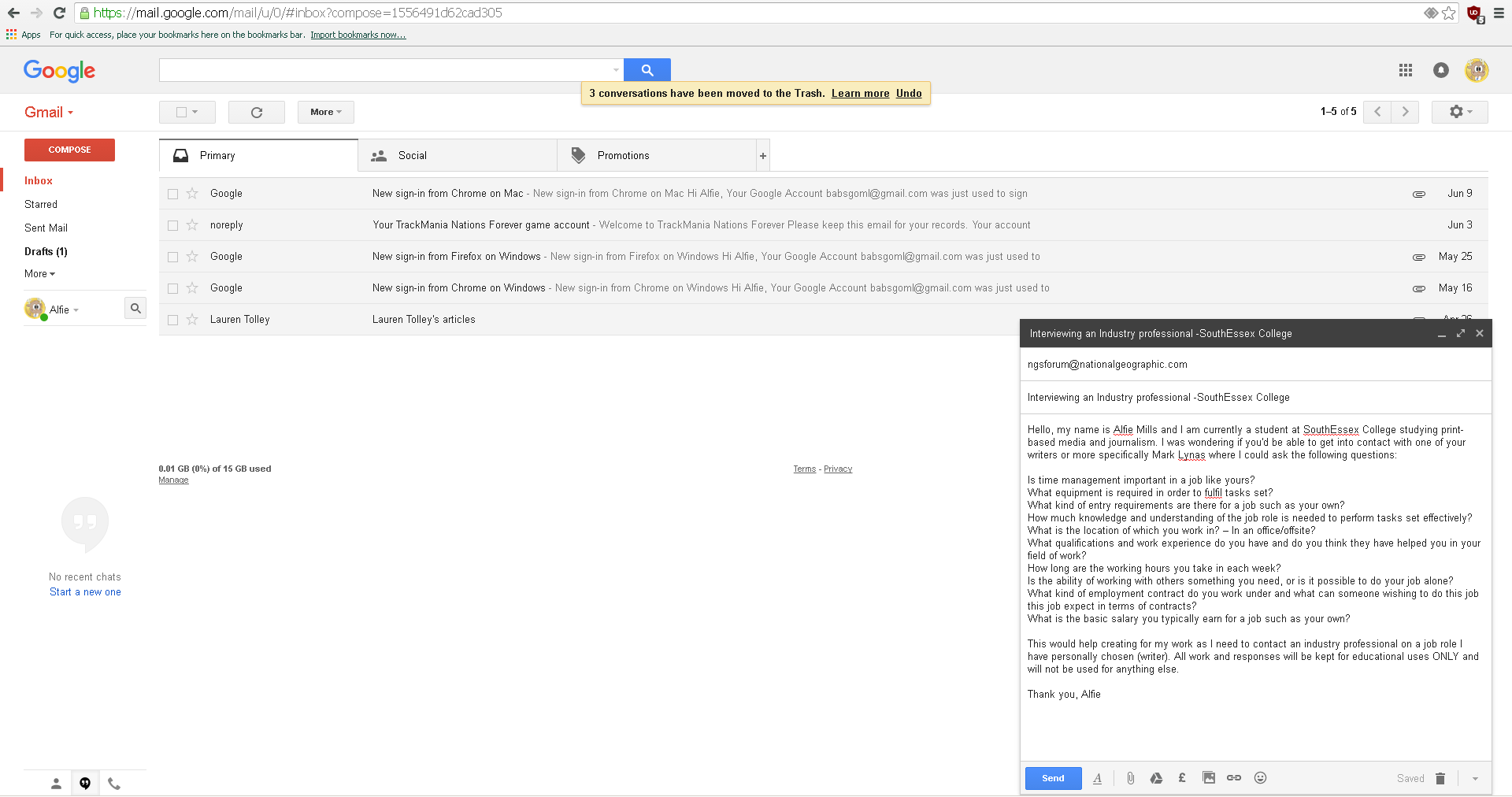 |
| Composing the email to National Geographic Magazine |
 |
| Response to my original email |
Subscribe to:
Comments (Atom)