Scenario -
You are a showbiz journalist and have been given a good tip by a reliable contact that an A-list celebrity is having a secret relationship with a married Premiership footballer. How would the legal term of libel (defamation) apply and what legal aspects would you have to take into consideration before your story is published?
Definition of Libel -
The legally indefensible publication or broadcast of words or images that are degrading a person or injurious to his or her reputation.
Answer to the scenario -
A big thing for the news is always to only publish and present what is complete fact, this is important because libel can take into affect here. Even if it is the truth, you must back it up, have an official statement and make a story on it after it has happened. You aren't allowed to make a story on the something which is based on speculation as that wouldn't be classified as news. For harmless topics this can be allowed but wouldn't be published from any big producer of the news today.
In this case, we are dealing with something highly controversial and also something which could be damaging to the reputation of both parties involved. This is why I mentioned that its important not to report on speculation or something which might not be completely true. Often though, you will see gossip magazines and such report on a story like this after its already happened and been made public by someone directly involved.
Avoiding breaking the law by not publishing a story based speculation is not only good journalistic practice but also keeps you and your company from being under fire and sued for millions potentially. This is the exact same in how a journalist should only report what is complete fact, lying will only get everyone into trouble as well as anyone else who may use that piece of information. Even if they quote you in and say where the information you got was sourced.
Task 2:
For task two I found a website in which went over some of the not only most well know cases of libel but also successful, the full site can be found here as its an interesting read: http://www.insidecounsel.com/2014/11/18/6-most-successful-celebrity-libel-and-slander-case?slreturn=1465232280
In specific, I want to focus on the 2nd story written here as its the one that stands out to me the most.
So what happened?
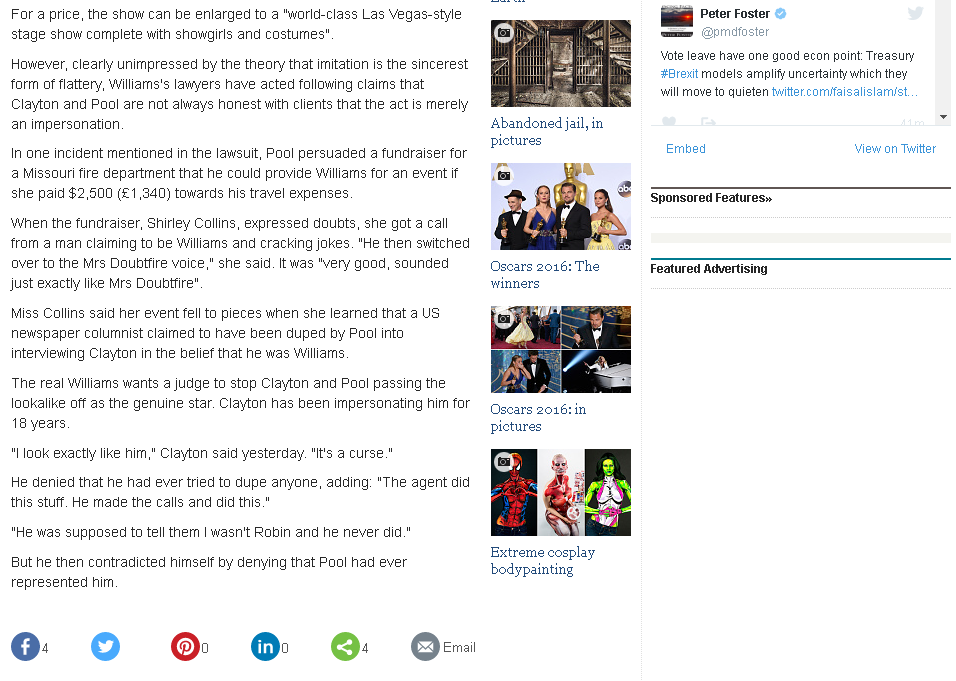
A look-alike of Robin Williams and his agent were pretending to be the actual Robin Williams where the look-alike was actually cheating charities under the name of Robin Williams. In turn this caused a lot of damage to Robin Williams' name and reputation.
Another article on the matter can be found here in which the Telegraph took their take on the turn of events:
http://www.telegraph.co.uk/news/worldnews/northamerica/usa/1489946/Robin-Williams-sues-the-lookalike-he-accuses-of-fooling-the-fans.html
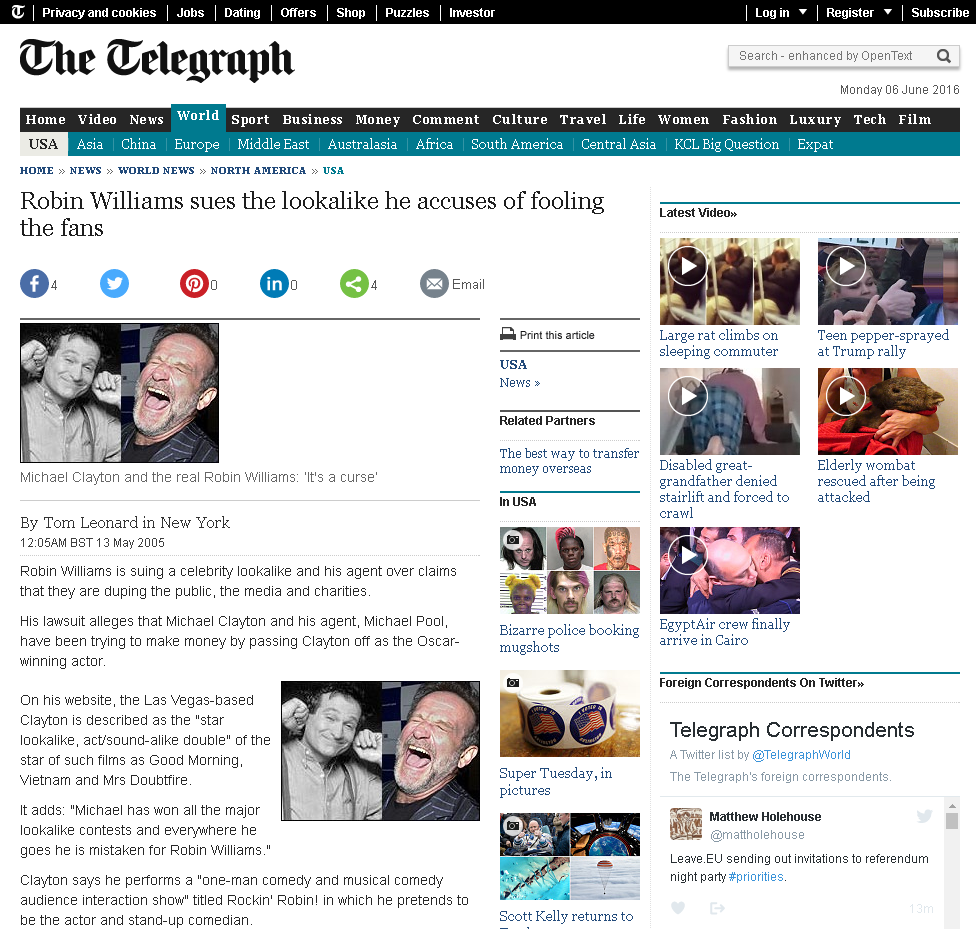
The story pasted here -
My findings -
From this article we get to follow the story of Robin Williams and his proceedings in suing the look-alike of him who cheated charities and in Robins words, fooled the fans.
It's also important to point out this article underlines how serious this issue is and how its dealt with and same with the other article posted above, its not the only time defamation has happened, this has happened a lot.
Task 3:
Scenario -
you are about to publish an online book, via Kindle, which is your own creation. Why would the law of UK Copyright be so significant?
Answer to the scenario -
From this article we get to follow the story of Robin Williams and his proceedings in suing the look-alike of him who cheated charities and in Robins words, fooled the fans.
It's also important to point out this article underlines how serious this issue is and how its dealt with and same with the other article posted above, its not the only time defamation has happened, this has happened a lot.
Task 3:
Scenario -
you are about to publish an online book, via Kindle, which is your own creation. Why would the law of UK Copyright be so significant?
Answer to the scenario -
Copyright
when publishing anything anywhere is always an underlying factor.
In this
scenario, we’ll be publishing a book online to Kindle. Copyright comes in
extremely helpful here as often, online, it is common that a lot of things can
be illegally downloaded or plagiarised with little consequences because of it.
There’s a certain level of anonymity in which a person can hide behind when
online and it is abused every minute.
Because of
this, you want to stay clear of copyright laws and not fall under receiving
legal action taken against you. Everything in your book should be your original
and own content. If it is sourced from somewhere, it should be your own words
with references made to where you sourced the information at the end of the
book. Plagiarising is against the law and you will be breaking copyright laws
by failing to not put your own writing into it.
Unfortunately,
it doesn’t end there for copyright. On top of this, another part of copyright
that you have to abide by is having a unique title for your book. This is
important in particular because like how you can’t make your own drink and name
it Coca-Cola, you can’t produce a book and call it James and the Giant Peach.
It has to be your own and original.
Copyright
is a form of intellectual property, and so by staying in line with the law of
copyright, your own worked will be protected as well as not being in trouble
with others and the work they have produced.
So assuming
all of the content of your book is completely yours unless sourced correctly
and produced for educational use with the consent of the original author, as
well as the title of your book is your own, everything should be in check. Your
book after meeting all these requirements will then be able to be published if
Kindle decides to take on your book and feature it in their library.
If you
violate copyright law, you can and will be given a fine or complete rejection
from whoever you are trying to get to publish your book. Even if a publisher
takes on your book and it is then produced and sold, you can’t still get into
legal trouble, as well as the publisher.
Cases where
the original publisher of whose work you’ve copied finds out and then decides
to threat legal action against you or even take you straight to court to sue
you for copyright can still happen and its not extremely uncommon. Copyright infringement
happens often in todays world, especially in publishing and media creation.

No comments:
Post a Comment